
What may remain valuable when the owner steps away?
Business goodwill in a sale is the value associated with advantages that remain connected to the operating business rather than being identified and valued separately as an asset. Those advantages may include the business location, an in-place workforce, proprietary software, documented designs, drawings and a website. Goodwill therefore sits within the value of the business as a functioning operation; it is not simply the amount you hope to receive above the recorded value of its assets.
Transferability is the practical question for sale preparation. Ask whether customers, earnings, systems, relationships, people and operating knowledge can continue through the business after you leave. A business that depends heavily on your personal decisions, contacts or undocumented knowledge presents a different goodwill question from a business supported by capable management, documented procedures and relationships held through the company. The distinction does not produce a goodwill figure by itself, but it tells you which evidence needs attention before sale discussions.
Your first task is not to assign a number to goodwill. Your first task is to show what a buyer would receive, what would continue after completion and what still depends on you. That file gives later valuation work a clearer subject and a more disciplined starting point.
Place goodwill within the value of the whole business
The value of the whole business includes more than goodwill. It may involve tangible assets, identifiable intangible assets and the operating advantages associated with the business as a going concern. A valuation estimates value for the defined business, ownership interest or asset; it does not itself verify every piece of information supplied about that subject. Goodwill must therefore be considered in the context of the business, the interest being transferred and the purpose of the valuation.
The label “goodwill” should not become a shortcut for everything that has not yet been described. Under AASB 138, an identifiable intangible acquired in a business combination is recognised separately from goodwill when it is separable or arises from contractual or legal rights. AASB 3 also distinguishes a business combination from an asset acquisition by asking whether the assets acquired and liabilities assumed constitute a business. These accounting distinctions show why the subject of the sale needs to be mapped before a conclusion about goodwill is drawn.
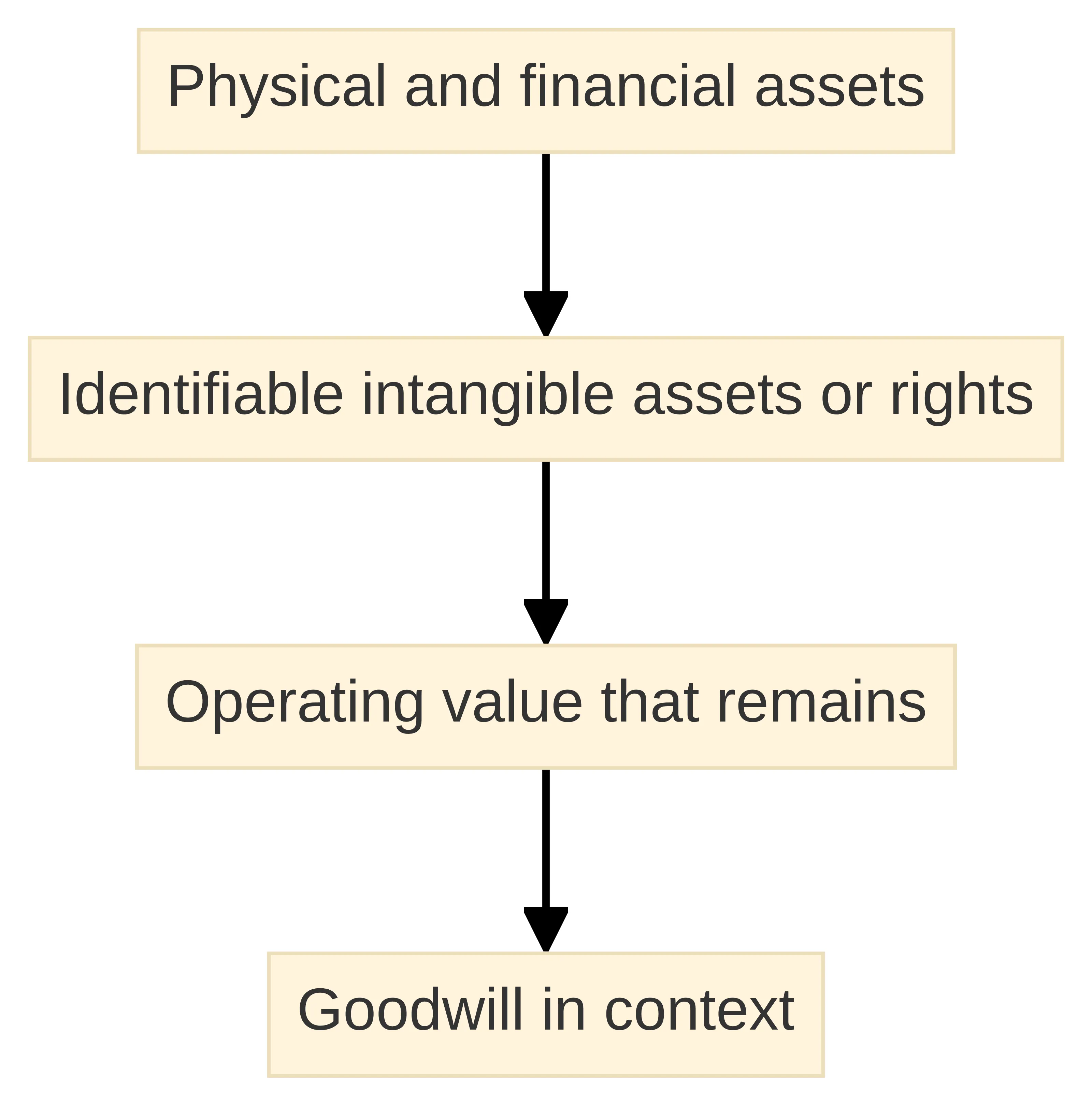
For sale preparation, use three questions to keep the discussion in order:
- What physical and financial assets are included?
- Which identifiable intangible assets or rights belong to the business?
- What operating value remains after those items are separately understood?
The third question is where goodwill may sit, but it should follow the first two rather than replace them.
Separate goodwill from identifiable IP and other intangible assets
Identifiable intellectual property and other intangible assets require separate attention from goodwill. A patent, trademark, contractual right, separable software asset or qualifying research and development project may have an identity and legal or contractual basis that is different from the broader operating value of the business. Goodwill can include business advantages such as location, workforce and proprietary software in the broader sale context, but that does not mean every item connected with the business belongs inside goodwill.
| Question | Goodwill | Identifiable IP or other intangible asset |
|---|---|---|
| What does it describe? | Operating value associated with advantages that remain with the business. | A distinct asset that may be separated or arise from contractual or legal rights. |
| What should you document? | How the business continues through people, systems, relationships and operating knowledge. | The asset’s identity, ownership evidence and relevant contractual or legal basis. |
| Why does the distinction matter? | It prevents the business’s transferable operating value from being treated as an unexplained remainder. | It allows an identifiable asset to be considered separately where the applicable acquisition and reporting rules require that treatment. |
Your preparation file should list each material IP and intangible item before you discuss goodwill. Include the name used inside the business, the entity that holds it, the records that support ownership and the commercial role it performs. Keep the description factual. A list of assets is not an individual valuation, and it does not decide how a particular transaction will treat those assets.
Test whether goodwill depends on the owner
Owner dependence is a central test of transferability. A goodwill assessment should consider whether value depends primarily on you or can continue through the business without you. The evidence also distinguishes enterprise goodwill, supported by capable management, from personal goodwill that depends heavily on the owner. These descriptions address related questions: who carries the knowledge and relationships, and whether the operating business can carry them forward.
Use the following questions to expose dependence before a buyer raises it:
- Which customer, supplier and referral relationships are maintained through your personal phone, email or reputation?
- Which significant decisions require your approval because no other person has the authority or knowledge to make them?
- Could a manager explain the daily operating rhythm, pricing decisions, service standards and escalation process without relying on your memory?
- Which technical, commercial or historical knowledge exists only in conversations rather than in business records?
- Which revenue relationships would need a personal handover from you before another person could manage them?
The answers do not establish a goodwill amount. They identify the parts of the business that need documentation, delegation or a clear transition plan.
A business with management capable of running day-to-day operations without constant owner involvement gives you clearer evidence of enterprise continuity. If your business still depends on you for significant decisions, record those dependencies honestly and prepare a plan showing which responsibilities can move into the business.
Check whether the business can operate and transfer without the owner
Operational continuity is the practical expression of transferable goodwill. Written procedures, operating manuals and training records can help demonstrate that the business can continue without you. Capable management matters because a buyer needs to understand how work is performed, who is accountable and how decisions move when the former owner is no longer present.
Review the business in four layers:
- Daily operations: Identify recurring work, approvals, service standards and escalation points.
- People: Record who performs each activity, who can cover it and where training is still informal.
- Knowledge: Capture pricing logic, technical instructions, customer history and supplier knowledge that currently sits with you.
- Transition: Separate duties that can transfer immediately from duties that need a structured handover.
This review is not a promise that a buyer will accept the business at a particular price. It is a way to show where continuity is supported and where owner involvement remains a commercial consideration.
A sale file should distinguish between “the business can perform this activity” and “I personally perform this activity.” That simple distinction prevents general claims about an established operation from obscuring a dependency that may affect negotiations, transition planning or the scope of valuation work.
Examine relationships, revenue durability and commercial evidence
Business relationships support a transferability assessment when the relationships are documented and held through the business. Customer records in a CRM, supplier agreements held by the business entity and client contact managed through business channels can make those relationships more transferable to a buyer. Personal goodwill concerns arise when a relationship is understood to belong mainly to you rather than to the company.
Commercial evidence gives context to those relationships. Useful preparation materials include market conditions, sales information, forecasts, business history, documented procedures, business plans, opening hours and premises details. The purpose is not to present every favourable fact in isolation. The purpose is to let the valuation discussion connect revenue activity, operating arrangements and the circumstances in which the business trades.
Ask yourself:
- Where are sales records kept, and can another person trace the relationship from enquiry to invoice?
- Which customer or supplier arrangements are documented in the business’s name?
- Which forecasts have clear supporting information and which depend on your personal expectation?
- How would a buyer understand the business’s market position, trading history and premises arrangements?
Use the answers to separate documented commercial evidence from assumptions that still need support. Do not present a forecast, relationship or market advantage as transferable merely because it has existed during your ownership.
Make transferability visible through systems and records
Systems and records make an operating business easier to understand after ownership changes. Written procedures, training documentation and operating manuals can help show how the business continues without you. Retaining relevant records and documenting the valuation process can also support a replicable and defensible valuation report. Records do not create goodwill by themselves; they make the underlying business characteristics easier to examine.
Build a working file with sections for:
- operating procedures and training materials;
- customer and supplier records maintained through business systems;
- sales reports, forecasts and the assumptions supporting them;
- business history, plans and premises information;
- licences, contracts, equipment, inventory, liabilities and IP records; and
- a schedule of matters that still depend on your knowledge or approval.
Give each document a clear date, owner and description. Keep the source record with any summary so that the context is not lost when information is passed to an adviser or prospective buyer.
A useful test is whether another informed person could follow the file and understand how the business operates without asking you to reconstruct its history from memory. Where the answer is no, identify the missing record and assign a practical owner for completing it before sale discussions progress.
Run a sale-readiness evidence sweep
Sale-readiness evidence covers more than financial statements. Before sale discussions, review licences and permits, contracts and leases, supplier agreements, equipment, intellectual property, inventory and liabilities. Also assemble market and sales information, business history, documented procedures, business plans, opening hours and premises details. These categories help you identify what a buyer or adviser will need to understand about the operating business.
Use this sweep as a short working checklist:
- Regulatory and operating permissions: List licences and permits and record their status.
- Premises and contracts: Gather leases, contracts and supplier agreements relevant to continued operation.
- Assets and obligations: Record plant, equipment, inventory, intellectual property and liabilities.
- Commercial information: Assemble market context, sales reports, forecasts and business history.
- Operating evidence: Gather procedures, staff or training material, business plans, opening hours and premises details.
- Goodwill evidence: Mark the customer relationships, workforce, systems, location and knowledge that would remain with the business after your exit.
Use the checklist to locate records and gaps. Do not treat a completed tick-box as proof that a buyer will accept a conclusion about goodwill.
Prioritise gaps that affect continuity, ownership or the ability to explain revenue. A missing description of a routine process may be repairable through documentation. An unclear right to use an important asset needs a different follow-up and belongs in the contractual review. For each gap, record the evidence currently held, the business consequence, the person responsible for resolving it and the point at which it should be checked again. This creates a working register rather than a static checklist. A gap about an undocumented routine points to continuity evidence; a gap about who owns an IP item points to rights evidence; a gap in sales records or forecasts points to commercial support. Keep those categories separate when briefing an adviser, because a missing record, an unresolved ownership question and an unsupported commercial assertion are different limitations. Closing one gap should not be described as proving goodwill. It only improves the factual record from which transferability and the defined subject of a valuation can be considered.
Verify ownership and contractual rights before sale discussions
For each material IP or intangible item, record:
- the asset or right’s plain-language description;
- the entity or person shown as owner or contracting party;
- the agreement, registration or other record that supports the position;
- the business activity that uses the item; and
- any ownership question that needs professional review before it is presented to a buyer.
Apply the same discipline to premises, supplier arrangements and other contracts that support continued operations. Keep the factual record separate from your view of what the item may be worth.
AASB 3 distinguishes a business combination from an asset acquisition based on whether the assets acquired and liabilities assumed constitute a business. That distinction is transaction-specific. Your preparation file can identify the assets, rights and liabilities involved, but it should not assume the accounting treatment of a future transaction.
Understand what preparation can and cannot establish
Preparation can organise the evidence behind transferability, ownership, operations and commercial performance. Preparation cannot establish an individual goodwill figure without reviewing the specific business, its records, the defined interest and the purpose of the work. A valuation is an estimate of value for the defined business, interest or asset, and it does not itself verify all information about that subject.
For Australian tax purposes, the ATO states that market value requires consideration of the asset or business, its environment and market, together with other relevant factors. The ATO also states that responsibility for a replicable and defensible valuation remains with the taxpayer even when a professional is engaged. Retain the relevant records and document the information used so that the basis of the work can be followed.
Do not treat any of the following as a goodwill conclusion on its own:
- a strong trading year;
- a long operating history;
- a high owner income;
- a list of unregistered business advantages;
- an asking price from another business; or
- a spreadsheet that assigns a figure without explaining the business, evidence and purpose.
These items may belong in the information pack, but they need context. A defensible discussion depends on the complete fact pattern rather than a single favourable indicator.
Decide when specialist valuation input is warranted
Specialist valuation input is warranted when goodwill is material to the sale conversation, when owner dependence affects the transfer question, when identifiable IP or other intangible assets may need separate consideration, or when the valuation will be used for a defined tax, court, investor or transaction purpose. The need is stronger when the available records cannot explain how the business generates and retains value after your exit.
Use this decision path:
- If you are still assembling the evidence: complete the records sweep and identify ownership, continuity and commercial gaps before seeking a conclusion.
- If goodwill is central to the expected sale value: prepare the owner-dependence and transferability file, then seek a defined valuation scope rather than relying on an informal estimate.
- If IP, AI technology or other identifiable assets are material: list those assets separately and provide the rights and ownership records with the business information.
- If the valuation has a tax, court, investor or transaction use: state that purpose at the beginning of the enquiry so the scope and report use can be considered together.
Each path ends with a defined information and scope discussion. None establishes a goodwill figure before the business has been reviewed. Before making an enquiry, turn that decision path into a short scope brief. Identify the subject under discussion—whole business, ownership interest or a particular intangible—the reason the valuation is needed, the intended reader or use, and the records available together with their known limitations. This matters because value is estimated for a defined subject and purpose, not for an undefined collection of goodwill-related advantages. It also helps separate a request to understand sale readiness from a request for a formal valuation. Include the owner-dependence findings, the list of identifiable assets and rights, and the material gaps in continuity evidence. Do not fill those gaps with assumptions or present an indicative range as a conclusion. The specialist can then consider what information is relevant, what questions require clarification and whether the requested work matches the intended use. If the intended use changes, revisit the scope rather than treating an earlier discussion as automatically suitable for the new purpose.
We provide AFSL-licensed valuations of businesses, intellectual property and AI technology. We build valuations by analysing financials, risk and the market, and we prepare valuations using the approach suited to the client’s purpose. Our stated work is directed to independent valuations for the standards expected by buyers, investors, courts and the ATO. A defined enquiry is still needed to establish the subject, purpose, information required and scope.
Prepare the information for a valuation enquiry
A sale-ready goodwill file should show what continues through the business after you step away and what still depends on you. Gather financial and sales information, forecasts, business history, procedures, plans, premises details, licences, contracts, leases, supplier agreements, equipment, inventory, liabilities, IP records and evidence of customer and workforce continuity. Add a short schedule of open questions rather than hiding gaps inside a general summary.
A qualified professional must decide what input is suitable for your individual purpose and circumstances. Your records can support that discussion, but they cannot confirm a goodwill figure or formal valuation on their own. An enquiry also does not confirm an appointment or formal valuation.
If your information is organised and you want to discuss the appropriate scope, the configured enquiry is the next step.
What should an owner ask before seeking goodwill input?
What is business goodwill in the context of a sale?
Business goodwill refers to the value associated with advantages that remain connected to the operating business, such as location, an in-place workforce, proprietary software, and documented designs. It is not simply the amount hoped to receive above the recorded value of assets.
How can I assess whether goodwill is transferable in my business?
To assess transferability, consider whether customers, earnings, systems, relationships, and operating knowledge can continue through the business after you leave. A business that relies heavily on your personal involvement presents different challenges compared to one supported by capable management and documented procedures.
What should I include in my sale preparation file regarding goodwill?
Your sale preparation file should document what continues through the business after you step away, including financial and sales information, forecasts, business history, procedures, plans, and evidence of customer and workforce continuity.
What distinguishes personal goodwill from enterprise goodwill?
Personal goodwill is tied to the individual owner and their relationships, while enterprise goodwill exists when a business can operate independently of the owner, supported by capable management and documented processes.
What types of records should I gather to support a valuation of goodwill?
Gather records that include operating procedures, training documentation, customer and supplier agreements, sales reports, business plans, and any relevant contracts or leases that support the continuity of the business.
When should I seek specialist valuation input for goodwill?
Specialist valuation input is warranted when goodwill is material to the sale, when owner dependence affects transferability, or when identifiable intangible assets may need separate consideration.
What are the key factors to consider in a goodwill assessment?
Key factors include the business’s operational continuity, the documentation of customer and supplier relationships, the management’s capability to run operations without the owner, and the presence of identifiable intangible assets.