
Start with the decision your technology company must make
The label business advisory accountant does not tell you whether the support you need is accounting, general business advice, valuation or corporate finance. Start with the decision in front of your company. A technology business preparing a forecast has a different requirement from one assessing an acquisition, licensing its software or preparing for a sale.
The decision usually becomes clearer when you identify four things:
- the event creating the need, such as growth funding, an acquisition, restructuring, licensing or a potential exit;
- the subject being analysed, such as operating performance, cash flow, shares, the whole business, intellectual property or a specific technology asset;
- the people who will use the work, such as management, a board, shareholders, a lender, an investor or a transaction counterparty; and
- the action that may follow, such as changing the forecast, raising capital, negotiating a licence, setting a transaction position or deciding whether to proceed.
This first definition prevents a common category error: asking an accountant for a transaction valuation, asking a valuer to resolve a tax-compliance issue, or assuming that a corporate finance adviser provides the same service as a financial adviser.
A financial-control question points towards accountant-supported work. Examples include understanding the company’s financial position, preparing or managing cash flow, forecasting, benchmarking performance and dealing with regulatory or Australian Taxation Office requirements. The Queensland Government lists these among areas where accountants can help businesses. That does not make every accountant a transaction adviser, so keep the required outcome visible.
A strategic or transactional question points towards a different capability. You may need a defined valuation, support for a capital-raising decision, advice on an acquisition, help with a licensing arrangement, preparation for a sale or analysis of an IP-rich business. In those situations, the quality of the engagement depends on whether the adviser understands the relevant technology, the rights attached to it and the decision that will use the work.
The practical answer is simple: name the decision before you name the adviser. If you cannot state what the company needs to decide, spend time clarifying that question before comparing providers.
Separate accounting, business advisory, valuation and corporate finance
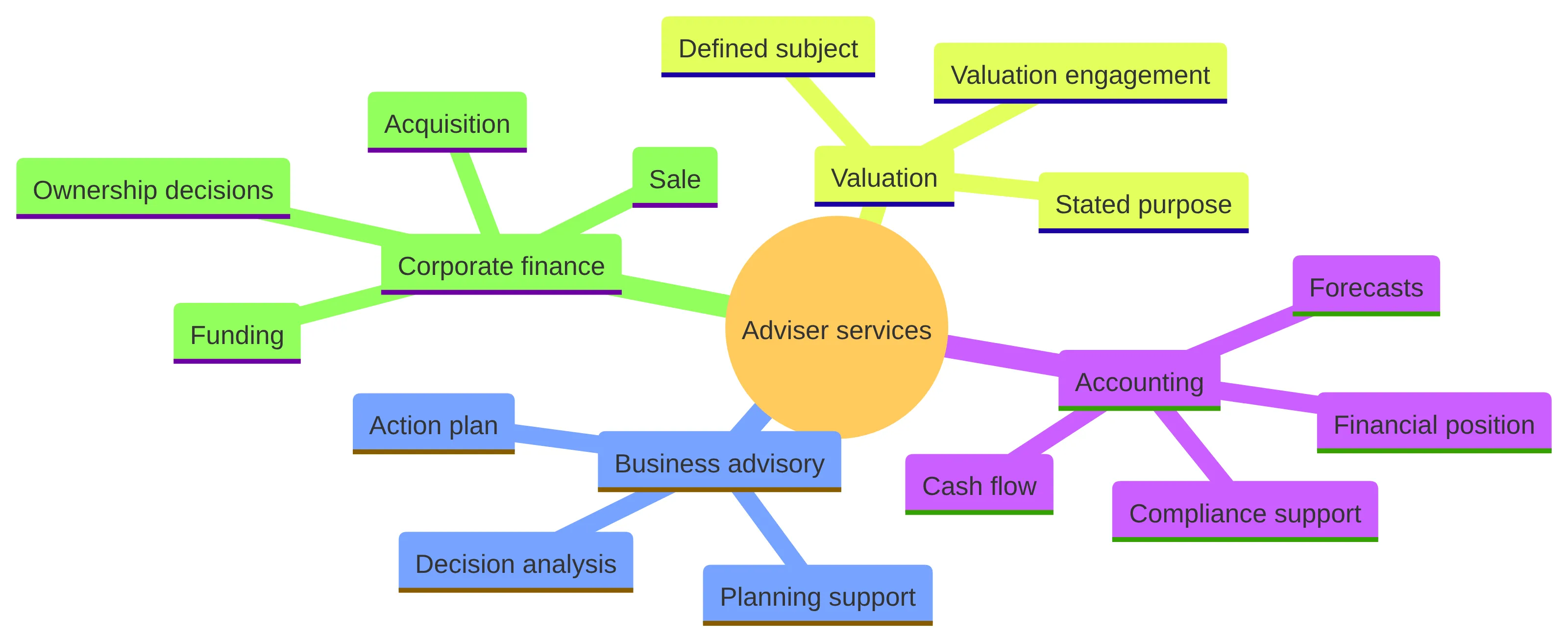
Accounting, business advisory, valuation and corporate finance can overlap, but they do not describe the same deliverable. Accounting support generally starts with financial information and its management. Business advisory may use that information to help you plan, compare options or manage a commercial decision. Valuation addresses the value of a defined subject for a stated purpose. Corporate finance focuses on significant funding, ownership, acquisition, sale, restructuring or other capital decisions.
The Queensland Government distinguishes accountants from financial advisers and describes accountants as helping with areas such as cash flow, forecasting, financial position, benchmarking and regulatory requirements. It describes financial advisers as providing specialised, circumstance-based advice about areas including investments, financial products, business structures and wealth management. APES 225, meanwhile, recognises valuation engagements, limited-scope valuation engagements and calculation engagements as valuation-service categories. These distinctions give you a practical starting point, not a reason to force every need into a single professional label.
Use this comparison to identify the service you are actually asking for:
| Capability | Main question it helps address | Typical output to define | Boundary to keep clear |
|---|---|---|---|
| Accounting | What is the company’s financial position and how is performance being managed? | Financial information, cash-flow work, forecasts or compliance-related support | It may not answer a transaction-value or IP-value question |
| Business advisory | What commercial decision should management examine and how should it be organised? | Decision analysis, planning support or a structured action plan | It is not automatically a formal valuation or financial-product recommendation |
| Valuation | What defined business, interest, IP asset or technology is being valued for a stated purpose? | A valuation engagement, limited-scope valuation engagement or calculation engagement | The scope, assumptions, users and purpose affect what the work can support |
| Corporate finance | How should the company approach a funding, acquisition, licensing, sale or ownership decision? | Transaction or capital-decision advice, often incorporating valuation work | It does not replace accounting, tax or legal advice |
If the requirement crosses two categories, state both rather than treating the overlap as proof that one provider covers every task.
A technology CEO may use the word advisory to describe almost any help with a difficult decision. That is understandable, but it can make proposals hard to compare. Replace the broad label with a sentence such as: We need to understand cash requirements for the next planning period; we need a valuation of the company for a capital discussion; or we need advice on a possible sale of an IP-rich business.
That sentence tells you what competence to test. It also makes it easier to identify work that belongs with your existing accountant, work that requires a valuation specialist and work that calls for corporate finance support. The aim is not to find the broadest provider description. It is to define the engagement that can answer your question.
Use accountant-supported services for financial control and forecasting
Accountant-supported services are relevant when your immediate problem concerns financial control, cash movement, forecasting or the interpretation of operating performance. For an established Australian technology company, that may mean building a clearer view of recurring revenue, development expenditure, working-capital pressure, cash requirements or the effect of planned hiring. The exact work still needs to be defined with the professional who will perform it.
The Queensland Government lists banking solutions, cash-flow preparation and management, regulatory requirements, financial benchmarking and forecasting among areas accountants can help with. It also says accountants can help businesses understand their financial position and industry benchmarks and meet Australian Taxation Office requirements. These are useful indicators for deciding whether your first conversation belongs with an accountant or bookkeeper rather than a valuation or corporate finance specialist.
Use accountant-supported work first when you need to:
- organise reliable management information before making a strategic decision;
- understand how cash moves through the business and how a proposed plan affects it;
- prepare forecasts or compare actual performance with industry benchmarks;
- address accounting or ATO-related requirements within the accountant’s remit; or
- prepare financial information that another adviser will need for a valuation, funding or transaction discussion.
This sequence matters. A valuation or capital discussion built on unclear financial information may require additional assumptions or a narrower scope. Improving the underlying records can therefore be a sensible preparatory step, while still leaving the strategic or transactional question for the adviser equipped to answer it.
Financial control is not the same as deciding what the company is worth or how a transaction should be structured. A forecast can show the cash effect of a plan, but it does not by itself establish the value of shares, an IP portfolio or a business. Likewise, a set of accounts can support a transaction analysis without answering every question about technology rights, licensing economics or buyer fit.
Keep the handoff explicit. Ask your accountant to identify the financial information relevant to the decision, then define separately whether you need valuation, corporate finance, legal or other specialist work. You will have a clearer brief and fewer assumptions about what the original engagement covers.
Recognise when the requirement has become strategic or transactional
The requirement becomes strategic or transactional when the answer may change ownership, funding, control, commercial rights or the future direction of the company. A normal planning discussion can then become a question about value, risk, negotiation position or execution.
Look for these signals:
- Growth funding: you are considering external capital and need to explain the company, its financial outlook, its technology and the basis for the funding discussion.
- Acquisition: you are assessing a target, the value of a business or the value of particular technology rights. APES 225’s examples include limited-scope valuation for mergers-and-acquisitions advice.
- Restructuring: the company needs to reconsider its operating or ownership arrangements and the consequences may extend beyond routine financial reporting.
- Licensing: you are deciding whether, how or on what terms to grant rights over software, data, patents, a platform or another intangible asset.
- Valuation: a board, shareholder, investor, lender or transaction participant needs an analysis of a defined business, interest or asset for a stated purpose.
- Sale preparation: you are considering a sale of the company, an IP asset or an IP-rich business and need to understand what is being presented and how the process should be managed.
These signals do not determine the answer by themselves. They tell you to test whether the proposed adviser has the relevant transaction, valuation and technology scope before treating the engagement as general business support.
For growth funding, begin by defining whether the immediate need is financial forecasting, an equity valuation, capital-raising support or a broader corporate finance assignment. For an acquisition, identify whether you need target analysis, valuation, diligence coordination, negotiation support or several of these. For restructuring, separate the operating, ownership, financing, accounting, tax and legal questions before assigning work.
For licensing, identify the right being granted, the owner, the proposed user, the territory, the commercial purpose and the information available to support the arrangement. For sale preparation, identify whether the subject is the whole company, shares, selected assets or an IP-rich business. A specialist valuation or transaction adviser can then assess whether the requested work is within its scope.
Take the direct action that follows from the trigger: write the decision, the subject and the intended user of the work in three lines before you approach a provider.
Check whether technology rights and intangible assets drive the decision
Technology companies often carry value in assets that are not captured by a simple description of revenue or equipment. The relevant subject may include patents, trademarks, data assets, an R&D pipeline, a proprietary platform, a machine-learning platform or an algorithm-driven business. The point is not to assume that every intangible asset has a separate value. The point is to identify whether technology rights or technology-dependent capability affects the decision you need to make.
Our stated valuation scope includes specialist valuations for patents, trademarks, data assets, R&D pipelines and proprietary platforms. We also provide specialist valuations for AI companies, machine-learning platforms and algorithm-driven businesses. Those are defined capabilities to test against your requirement; they are not a conclusion about the value of your own assets.
Before choosing an adviser, map the technology subject in plain language:
- What has the company created, acquired or licensed?
- Which rights does the company own, control or use?
- Which rights are registered, contractual, confidential or still under development?
- Which assets generate revenue, support delivery, reduce cost or create a potential licensing opportunity?
- Which records connect the rights to the company’s financial and commercial performance?
Use the map to determine whether your need remains financial-control work or has become an IP, AI, technology valuation, licensing or transaction question.
An intangible-asset arrangement can also raise questions outside valuation. The Australian Taxation Office identifies possible withholding-tax, transfer-pricing, capital-gains-tax and anti-avoidance issues in some arrangements involving intangible assets and offshore related parties. That statement applies to the arrangements described by the ATO, not to every licensing or technology transaction.
The practical boundary is specific: if your structure involves an offshore related party, do not treat a valuation or commercial licensing discussion as a complete answer to the tax questions. Record the arrangement, parties, rights and consideration clearly, then allocate tax and legal questions to the professionals responsible for them. Keep the valuation question separate so its subject and purpose remain understandable.
Match the immediate trigger to the specialist capability required
A useful adviser search starts with the immediate trigger rather than a generic service page. The following map shows how to translate a company event into a capability question. It is a screening tool, not a prediction of what your company should do.
If the trigger is financial control or forecasting, begin with accountant-supported work. Ask whether the provider can help you organise cash flow, forecasts, financial position and relevant benchmarks. The Queensland Government identifies these as areas accountants can help with.
If the trigger is growth funding, define whether you need financial preparation, a business valuation, equity-related analysis or broader capital-raising support. Do not assume that a forecast, a valuation and a funding engagement are interchangeable. State which output the decision-makers will use.
If the trigger is an acquisition, separate the target, the interest being considered and the purpose of the analysis. APES 225’s examples include limited-scope valuation for mergers-and-acquisitions advice, so ask whether the proposed valuation scope matches the acquisition decision.
If the trigger is restructuring, identify whether the work concerns operations, ownership, capital, reporting, tax or legal arrangements. A corporate finance adviser may address the capital or transaction question, while other professionals handle their own areas.
If the trigger is licensing, identify the IP, proposed rights, parties and commercial purpose. Sherwood Australia states that it structures and negotiates licensing arrangements to protect IP and capture its commercial value; test that stated capability against the exact rights and arrangement under consideration.
If the trigger is sale preparation, specify whether the subject is the whole company, an IP asset or an IP-rich business. Sherwood Australia offers sell-side advisory for IP assets and IP-rich businesses, managing that process from valuation to completion.
For each trigger, write one sentence beginning with We need to decide whether. Complete it with the decision, the subject and the intended use of the work. Then write a second sentence beginning with The adviser must understand. Complete it with the technology, rights, financial information or transaction context that cannot be treated as background detail.
This produces a more useful enquiry than asking for general business advice. It also exposes a mismatch early. If the provider can discuss only bookkeeping or forecasting when you need a defined IP valuation, the capability is too narrow. If the provider discusses a transaction without addressing the financial evidence, technology rights or intended users, the proposed scope may be too broad or incomplete.
Take the next step that matches the trigger: prepare a forecast brief for accountant-supported work, a defined subject-and-purpose brief for valuation, or a transaction brief for corporate finance and sale-related work.
Treat valuation as a defined engagement with an appropriate scope
Valuation is not a single undifferentiated product. APES 225 recognises valuation engagements, limited-scope valuation engagements and calculation engagements as valuation-service categories. Its examples include intellectual-property valuation and limited-scope valuation for mergers-and-acquisitions advice.
That distinction matters because the decision determines what the work needs to address. A valuation of a business for a capital discussion may differ from a valuation of an IP asset for licensing, a valuation of an equity interest for a transaction or a limited-scope analysis used within acquisition advice. The word valuation does not identify the subject, purpose, users, information, assumptions or limitations.
Define the engagement by recording:
- the subject: the company, shares, an equity interest, an IP asset, a technology platform or another defined item;
- the purpose: funding, acquisition, licensing, sale preparation, internal planning or another decision;
- the intended users: the board, shareholders, management, an investor, a lender or a transaction participant;
- the information available: financial records, forecasts, contracts, rights records, technical material and commercial evidence; and
- the permitted use: the decision or discussion for which the work is intended.
Then ask the proposed adviser which engagement category fits the question and what limitations follow from the information or time available. A clear answer is part of assessing fit.
Accounting information can be an input to valuation, but it is not the same as a valuation conclusion. Revenue, margins, cash flow and development costs help describe the business; they do not automatically establish the value of a patent, platform, shareholding or company. The same financial information can also be interpreted differently depending on the subject and purpose.
Keep the terms separate in your internal brief. Ask for financial-control work when you need reliable reporting or forecasts. Ask for valuation work when you need an analysis of value for a defined purpose. Ask for corporate finance support when the decision includes funding, ownership, acquisition, sale or negotiation. Where the work overlaps, list each output instead of relying on a broad label.
Apply a four-part adviser-fit test before making contact
Use four tests before you compare an adviser’s general credentials or service list. Each test asks whether the proposed engagement matches your decision rather than whether the provider uses familiar words.
1. Technology fit. Can the adviser understand the relevant technology and the rights attached to it? For an established technology company, that may include software, data, patents, trademarks, R&D, an AI system, a machine-learning platform or an algorithm-driven business. Ask how the subject will be defined and what technical or commercial material will be needed.
2. Decision fit. Has the adviser worked with the kind of decision you need to make? Funding, acquisition, restructuring, licensing and sale preparation each create different questions. Ask what the work is intended to help you decide and who will use it.
3. Engagement fit. Is the proposed scope clear about the subject, purpose, information, assumptions, limitations and permitted use? Ask whether the adviser is proposing a valuation engagement, limited-scope valuation engagement, calculation engagement, corporate finance assignment or another form of work. Do not accept a broad description in place of a defined output.
4. Boundary fit. Can the adviser explain where its work ends and where accounting, tax, legal or other professional input begins? Ask how conflicts, information gaps and changes in the transaction will affect the scope. A provider should be able to describe the boundary without implying that one engagement resolves every issue.
Record the answer to each test. A provider that fits the technology but not the decision may be unsuitable for the immediate need. A provider that fits the decision but cannot define the engagement may require clarification before you proceed.
Turn the four tests into a short scorecard with three columns: requirement, evidence in the provider’s stated scope and question still requiring an answer. For example, write technology rights under requirement, patents and proprietary platforms under stated scope if that is what the provider lists, and ownership records still to be discussed under the open question.
This keeps the assessment factual. It avoids ranking firms on vague claims and makes it easier to identify a narrow capability that fits the immediate task. It also gives you a record of why a provider was included for a particular discussion without treating initial contact as a commitment to an engagement.
Apply the scorecard before sending a long company history. First establish that the proposed capability relates to the decision; then supply the information needed to discuss scope.
Assess whether Sherwood Australia’s stated capabilities match the requirement
We offer IP valuation and AI and technology valuation services. We offer specialist valuations for patents, trademarks, data assets, R&D pipelines and proprietary platforms.
Those capabilities may be relevant when your decision depends on the value or commercial role of technology rights, an AI business, a platform, data, an R&D pipeline or another defined intangible asset. They do not remove the need to define the subject and purpose. A technology company should still explain whether it needs a company valuation, an equity valuation, an asset valuation or analysis connected with a transaction.
Use this part of our stated scope when your four-part test identifies a technology or intangible-asset requirement. If the immediate issue is routine financial control, cash-flow preparation, forecasting or ATO-related accounting work, the accountant-supported capability described earlier may be the more direct starting point.
We offer sell-side advisory for IP assets and IP-rich businesses, managing the process from valuation to completion. We also structure and negotiate licensing arrangements to protect IP and capture its commercial value.
This makes our stated scope relevant to two distinct situations: preparing an IP asset or IP-rich business for a sale process, and addressing the commercial arrangement around licensing rights. The two situations should not be combined automatically. A sale process has a different decision, timetable and set of users from a licensing arrangement.
Describe the exact requirement before treating either capability as relevant. State what is being sold or licensed, who owns or controls it, what commercial decision is pending and what information is available. That gives us a basis for discussing whether the proposed scope corresponds with the issue you have identified.
We also provide AFSL-licensed valuations of businesses, IP and AI technology. Our business page identifies Sherwood Australia with AFSL Licence No. 563351.
These statements describe our valuation credentials and regulatory position. They do not establish that every assignment has the same scope or that a valuation answers accounting, tax, legal, funding or transaction questions by itself. Use them as part of the fit test, alongside the subject, purpose, intended users, information and proposed engagement category.
Confirm valuation scope, assumptions and regulatory boundaries
A valuation discussion should make the proposed scope visible before the work is treated as an answer. Start with the subject and purpose, then ask how the information, assumptions and limitations will be handled. APES 225 recognises different valuation-service categories, and its examples show that intellectual-property valuation and limited-scope valuation for mergers-and-acquisitions advice can arise in different circumstances.
Use these questions to structure the discussion:
- What exactly is being valued: the business, shares, an equity interest, an IP asset, a platform, data, an R&D pipeline or another subject?
- What decision will use the work, and who are the intended users?
- Which records, forecasts, contracts, rights documents and technical materials will inform the analysis?
- Which assumptions depend on management information, future performance, ownership, licensing terms or transaction conditions?
- What limitations follow if information is incomplete, the scope is restricted or the analysis is required within a limited period?
- What is the proposed valuation-service category, and how will the report or analysis be used?
- Which accounting, tax, legal, financing or transaction questions remain outside the valuation scope?
The answers should be specific enough for you to understand what the work addresses and what it does not address. Do not treat a standards reference as a substitute for reading the defined assignment.
An AFSL reference and a valuation standard address the nature of the valuation service; they do not turn the engagement into tax, legal or accounting advice.
The boundary becomes especially relevant to intangible assets involving offshore related parties. The ATO identifies possible withholding-tax, transfer-pricing, CGT and anti-avoidance issues in some such arrangements. If that situation applies to your company, keep those questions distinct from the valuation scope and identify the professional work required for them.
The direct action is to ask for the proposed scope in terms you can carry into the board, shareholder, funding or transaction discussion. If the scope changes, record the change before relying on the work for a different purpose.
Keep accounting, tax, legal and financial advice within the right boundaries
Different professional questions can arise from the same company event. A proposed licensing arrangement may require commercial analysis, valuation, tax analysis and legal drafting. A capital-raising decision may require financial forecasts, valuation, corporate finance work, legal documentation and advice about financial products. An acquisition may require accounting analysis, valuation, diligence, negotiation and legal implementation.
The Queensland Government describes accountants as helping with financial position, forecasting, benchmarking, cash flow and ATO requirements. It distinguishes financial advisers as providing specialised, circumstance-based advice about investments, financial products, business structures and wealth management. The ATO separately identifies possible tax issues in certain intangible-asset arrangements involving offshore related parties. Keep those roles visible rather than describing all of them as business advisory.
Use a responsibility map with four columns:
- question to answer;
- professional capability required;
- information the professional will need; and
- decision or document the work will support.
For example, a question about the value of an IP asset is different from a question about the legal rights to use that asset, and both differ from a question about the tax treatment of an offshore arrangement. The same company information may be relevant to each question, but the conclusions are not interchangeable.
Do not ask a valuation engagement to determine whether a transaction is legally effective, whether a tax position is available, whether a financial product is suitable or whether accounting records meet every requirement. Do not ask a routine forecast to establish the value of a technology asset. Define the handoff instead.
This boundary improves decision quality because each professional receives a question that can be answered within the intended scope. It also prevents a broad service label from creating an assurance that the engagement has not been designed to provide. Put the responsibility map in your internal brief and update it if the transaction or intended use changes.
Prepare a focused brief for the first adviser discussion
A focused brief should explain the decision without attempting to replace the adviser’s work. Keep it short enough to read before a discussion and specific enough to expose the scope question.
Include these items:
- Company context. Describe the technology business, its main commercial activity, stage of development and the Australian setting in which the decision arises.
- Immediate trigger. State whether the trigger is growth funding, acquisition, restructuring, licensing, valuation, sale preparation or another event.
- Decision required. Write the decision in one sentence, including the date or stage at which it matters if that is known.
- Subject. Identify the company, shares, equity interest, IP asset, platform, data, R&D pipeline or other subject under consideration.
- Technology and rights. Summarise ownership, licences, registrations, development status, dependencies and any third-party rights that affect the subject.
- Financial information. List the accounts, management reporting, forecasts, cash-flow information and transaction assumptions available.
- Intended users. Identify the board, shareholders, management, investor, lender, buyer, seller or other party that may use the work.
- Required output. State whether you are seeking financial-control support, a valuation, licensing analysis, sale-side support, capital-decision advice or a combination with separate workstreams.
- Known boundaries. List accounting, tax, legal, financing or regulatory questions that must remain with the relevant professional.
Do not turn the brief into a promotional narrative. A clear list of facts, questions and unknowns is more useful.
Use the brief to test the four fit questions from this guide. Can the adviser address the technology? Does the work match the decision? Is the engagement category and scope clear? Are the boundaries visible?
If the requirement is a valuation involving IP, AI, technology or an IP-rich business, include the specific asset or business subject rather than writing only technology company. If the requirement is licensing, include the rights and proposed arrangement. If the requirement is sale preparation, state whether the subject is the business, an IP asset or an IP-rich business. These details determine whether a stated capability is relevant.
We offer IP valuation and AI and technology valuation services, specialist valuations for technology-related subjects, sell-side advisory for IP assets and IP-rich businesses, and licensing support. If your brief points to one of those areas, use the brief to frame the discussion rather than assuming the service description settles suitability.
Take the next step with a clearly defined requirement
The practical decision is not whether an adviser uses the broadest label. It is whether the adviser’s capability matches the decision, subject, intended users and scope your technology company has defined.
Use accountant-supported work for financial control, cash flow, forecasting, benchmarking and related accounting or ATO requirements. Separate those needs from valuation. Use a defined valuation engagement when the decision concerns the value of a business, interest, IP asset or technology subject. Use corporate finance or transaction support when funding, acquisition, licensing, ownership or sale execution is part of the question.
Those capabilities are relevant only when they match the requirement you have defined.
A qualified professional must decide whether any proposed service is suitable for your company’s circumstances. Prepare the brief, keep the professional boundaries visible and use the discussion to establish the possible scope without assuming that an initial enquiry confirms an engagement or an outcome.
A concise brief gives you a disciplined starting point: the trigger, decision, subject, technology rights, available information, intended users and required output. It also lets you distinguish a need for accounting support from a need for valuation, licensing or transaction advice before work begins.
What should an Australian technology company ask before engaging an adviser?
What does a business advisory accountant do for technology companies?
A business advisory accountant helps technology companies with financial control, cash flow management, forecasting, and compliance with regulatory requirements.
When should a technology company consider engaging a corporate finance adviser?
A technology company should consider engaging a corporate finance adviser when facing strategic decisions such as growth funding, acquisitions, licensing arrangements, or preparing for a sale. These situations require specialized knowledge and support beyond general accounting.
How can a technology company assess whether Sherwood Australia is the right adviser for their needs?
To assess whether Sherwood Australia is suitable, a technology company should evaluate the firm’s expertise in relevant technology, the specific decision to be made, the clarity of the proposed engagement scope, and the boundaries of the services offered.
What types of valuation services does Sherwood Australia provide?
Sherwood Australia provides investment-grade business valuations, IP valuations, AI valuations, and specialist valuations for patents, trademarks, data assets, and R&D pipelines.
What should a technology company include in a brief for an initial discussion with an adviser?
A brief should include the company’s context, the immediate trigger for the discussion, the decision required, the subject of the valuation or advisory, relevant technology rights, available financial information, intended users of the work, and known boundaries for accounting, tax, or legal questions.