
Start with the management decision, not the adviser’s title
Business advisory support is most useful when a technology company needs to turn financial information into a management decision. Australian guidance describes business advisory as an expansion beyond compliance services, including proactive activities and client planning meetings. Related advisory work may cover cash-flow management, forecasting, financial benchmarking, banking solutions, and regulatory requirements.
For an established technology company, the practical question is whether those discussions can give the leadership team a clearer view of the decision ahead: how to plan growth, assess funding needs, understand a technology asset, or decide when a specialist valuation, licensing, or transaction conversation is relevant. The provider’s title is secondary to the decision and the working information.
Begin with a short management question rather than a broad request for business advice. Record:
- the decision currently in view, such as growth planning, capital raising, licensing, acquisition, sale, restructuring, or another defined objective;
- the financial information already available, including recent management information, forecasts, cash-flow information, and relevant assumptions; and
- the point at which the discussion may need specialist valuation, licensing, or corporate-finance support.
This creates a useful starting brief for an advisory conversation. It also separates an ongoing planning need from a defined specialist assignment, without assuming that one service label covers both.
What advisory support can cover
Business advisory support can cover the financial information and forward-looking questions that sit between routine records and a major corporate decision. The precise scope depends on the company, the objective, and the information available. Common areas include:
- cash-flow preparation and management;
- budgets, forecasts, and financial planning;
- financial benchmarking and interpretation of the company’s financial position;
- banking or funding discussions;
- regulatory requirements relevant to the business question; and
- proactive planning meetings that turn financial information into management decisions.
A CPA Australia guide describes advisory as an expansion beyond compliance services and refers to proactive, hands-on activities and client planning meetings.
Specialist corporate-finance support begins where the question requires analysis of value, ownership, rights, funding, or a transaction. APES 225 includes examples of intellectual-property valuation engagements and limited-scope valuations for mergers-and-acquisitions advice. That does not mean every technology-company question requires a formal valuation. It means the purpose and subject should determine the engagement.
For example, a technology company may need help connecting a forecast to a capital-raising discussion, separating the operating business from an IP asset, assessing the commercial value of a licensing arrangement, or preparing for a sale. A general adviser may be useful for financial planning, while a valuation or corporate-finance specialist may be relevant to the transaction-specific part. Treat these as related conversations, not as interchangeable services.
The practical boundary is the output you need. If you need to understand cash requirements under stated assumptions, begin with forecasting and cash-flow planning. If you need analysis of a defined business, ownership interest, or technology asset for a stated purpose, describe that as a valuation question. If you need help transferring, licensing, or selling rights, describe the commercial or transaction question separately.
These workstreams can inform one another, but combining them too early can make the brief difficult to interpret. State the immediate decision first, then identify the financial analysis or specialist service that may support it. This keeps routine financial management, proactive advisory, valuation, and transaction work distinguishable from the outset.
Recognize when external advisory support is relevant
External advisory support may be relevant when an important decision cannot be framed clearly from the company’s ordinary management reports alone. The signal is not simply that the business is growing or that the accounts are complicated. The signal is that you need an independent workstream, a defined analysis, or a structured discussion before choosing among material options.
Use these practical signals:
- A proposed capital raise requires a clear explanation of the business, its financial position, and the value question being presented to potential funders.
- A forecast, cash-flow issue, or funding requirement needs analysis beyond the preparation of recurring accounts.
- A technology asset may be contributing value, but its ownership, rights, financial treatment, or commercial use is not clearly separated from the operating company.
- A licensing, acquisition, sale, or management transition requires you to define what is being transferred, valued, negotiated, or protected.
- Several stakeholders need the same disciplined explanation before they can discuss the decision.
- The company needs to distinguish a management planning exercise from a formal valuation or another regulated service.
These signals do not establish that you need a particular provider or engagement. They tell you to define the question before selecting the support.
A short relevance screen can keep the first discussion proportionate. Ask yourself:
- What decision will be made after the work is completed?
- Who will use the analysis: the board, founders, existing shareholders, lenders, investors, a buyer, a licensing counterparty, or another group?
- What subject must be analyzed: the whole company, a division, a shareholding, or a defined technology asset?
- What information is available, and what assumptions would have to be made?
- Does the question involve a financial product or a regulated form of advice rather than only business planning or valuation?
ASIC’s published guidance includes materials on licensing, advertising, general and scaled advice, and product-design and distribution obligations. If your proposed discussion touches those areas, include the classification question in the scope conversation instead of treating all financial guidance as the same service.
A change in the audience for your financial information is another useful trigger. Management may be able to use an internal forecast for planning, while a lender, investor, buyer, board, or licensing counterparty may need a different analysis and a clearly stated purpose. That change does not automatically require a valuation or external adviser. It does mean you should identify who will rely on the work before deciding what to request.
Use that audience test alongside the decision test. If the same information must support several purposes, list each purpose separately and ask whether one proposed workstream can address them all. If the purposes differ, keep them as separate questions until the scope has been explained.
Build a management rhythm around financial information
A business advisory accountant can be considered as part of a decision rhythm rather than only as a provider of a one-off answer. The rhythm links the company’s current financial position to its forward view, then identifies when a specialist conversation is needed.
| Management focus | Information to keep in view | Possible discussion |
|---|---|---|
| Growth or scale planning | Cash-flow information, forecasts, planned investment, and assumptions | Cash-flow management, forecasting, financial benchmarking, or broader advisory support |
| Funding planning | Funding amount, intended use, ownership or repayment question, and forecast assumptions | Planning and forecasting, followed where relevant by capital-raising or valuation discussion |
| Technology or IP commercialization | The relevant asset or right, ownership information, revenue linked to it, and proposed commercial use | IP or AI valuation, licensing discussion, or transaction advisory |
| Acquisition or sale | The business, shareholding, IP asset, or defined technology subject and the intended use of analysis | Business valuation, IP valuation, buy-side or sell-side advisory, or limited-scope transaction work |
| Restructuring or management transition | Ownership, debt and funding position, operating structure, and the decision to be addressed | Financial planning, valuation, management buyout, or strategic transaction discussion |
Growth and funding planning can be part of an advisory relationship, while the latter questions may require a more defined specialist scope. That distinction helps a technology CEO decide what to raise first and which information to keep current, without treating every management discussion as a valuation engagement.
A capital-raising question illustrates why the distinction matters. A forecast may explain how additional funding could be used, while a valuation may address the value of the business or a defined technology asset for the stated purpose. A licensing question may require analysis of the relevant IP and the proposed rights, rather than a valuation of the whole company. A sale question may require a wider transaction process.
Do not combine those questions into a single request such as asking what the company is worth and how to raise money. State whether you need planning, valuation, licensing support, transaction preparation, or several separately defined workstreams. That wording gives an adviser a basis for explaining the proposed scope.
Clarify whether the question concerns the business, IP, or AI technology
The subject of the work should be named before you discuss value. A technology company may have several connected but distinct subjects:
- the operating business and its earnings or cash flows;
- a shareholding or other ownership interest;
- patents, trade marks, data assets, R&D pipelines, or proprietary platforms;
- software, machine-learning systems, algorithms, or AI technology; and
- contracts, licensing rights, or a transaction involving one or more of those subjects.
Sherwood Australia states that it provides specialist valuations for AI companies, machine-learning platforms, and algorithm-driven businesses. We also offer specialist valuations for patents, trade marks, data assets, R&D pipelines, and proprietary platforms. Those are different subjects even when they sit inside the same company, so your enquiry should identify which subject is relevant to the decision.
Rights and use should be separated from technical description. A software platform may be commercially important, but the work still needs to identify who owns the relevant rights, which rights are licensed, what evidence connects the asset to the business, and whether the proposed decision concerns the asset, the company, or both.
APES 225’s examples include an intellectual-property valuation engagement and a limited-scope valuation for mergers-and-acquisitions advice. The examples support a practical boundary: define the asset and the purpose rather than assuming that a broad technology description determines the scope. Before contacting an adviser, write a sentence in this form: the company needs to discuss [decision] concerning [defined business, interest, asset, or rights] for use by [intended decision-makers]. Then list any uncertainty about ownership, licensing, revenue, or access to records.
Use a three-part subject check before you send the enquiry:
- What exists? List the operating company, ownership interest, technology, IP rights, contracts, or other defined subject involved.
- What is connected? Note the revenue, costs, licenses, dependencies, or obligations that link the subject to the wider business.
- What is being decided? State whether the purpose is planning, funding, licensing, sale, acquisition, restructuring, or valuation.
This check helps prevent a technical description from becoming an imprecise valuation request. It also gives you a way to identify missing ownership or commercial information without treating the missing detail as a conclusion about value.
Hand off funding, licensing, and transaction questions clearly
Funding discussions are where an ongoing advisory conversation may need a clear hand-off. Keep the planning question separate from the valuation or transaction question: describe the intended use of capital, the relevant forecast and cash-flow assumptions, and the ownership or repayment issue. Then identify whether the next discussion concerns planning, a business or technology valuation, or transaction preparation.
We offer investment-grade business valuations, IP valuations, and AI and technology valuations, including valuation discussions connected with capital raising. A valuation is a defined analysis; it does not decide how much capital a company will obtain, which terms another party will accept, or whether a transaction will proceed. Keep those questions visible when deciding whether to move from general advisory support to specialist corporate-finance work.
Licensing questions should identify the right being licensed, the parties, the permitted use, the commercial purpose, and the information available about the asset. We state that we structure and negotiate licensing arrangements intended to protect IP and capture its commercial value. We also state that we help commercialize business or IP value through licensing deals, IP sales, and transaction advice.
Sale and acquisition questions need the same discipline. Identify whether the subject is the whole business, a shareholding, an IP asset, or a defined part of the technology. State whether you are considering a purchase, a sale, or an internal ownership change. APES 225 includes a limited-scope valuation example for mergers-and-acquisitions advice, so the transaction purpose and intended use should be explicit rather than implied.
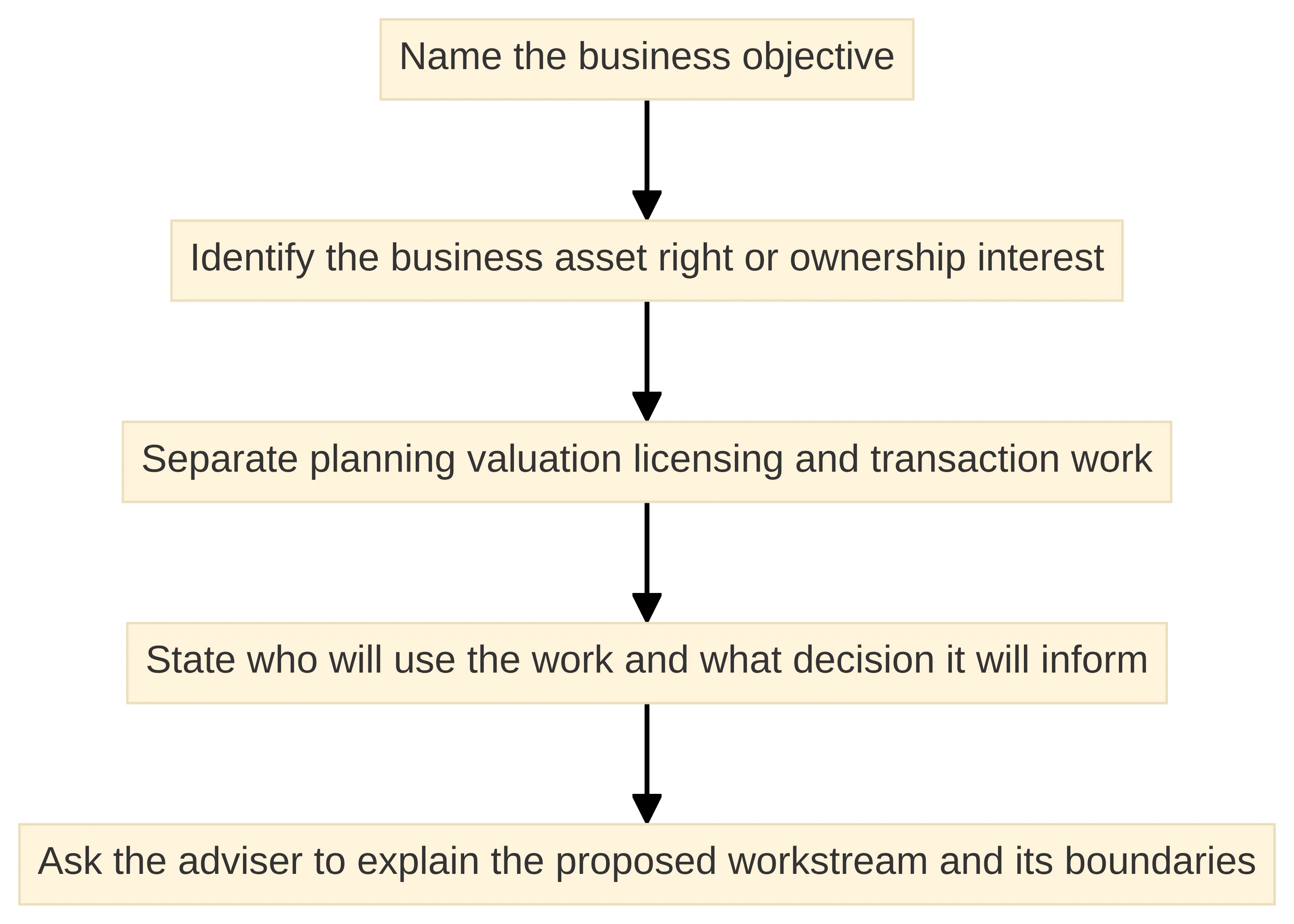
When more than one workstream is in view, keep the hand-off explicit:
- State the business objective and the decision it informs.
- Keep the forecast, cash-flow, and benchmarking discussion separate from any valuation or transaction analysis.
- Identify the business, asset, right, or ownership interest involved.
- State who will use the work and what information is available.
- Ask which service boundary applies next: ongoing advisory, valuation, licensing, or transaction support.
This approach keeps a recurring management discussion useful while giving a specialist assignment a defined starting point. A forecast remains distinct from a valuation, and an initial enquiry does not confirm funding, value, or deal terms.
Keep valuation and financial-advice boundaries clear
Valuation and financial-product advice are different questions. A valuation concerns the subject, purpose, scope, assumptions, and intended use of an analysis. Financial-product advice may raise separate questions about licensing, conduct, disclosure, general advice, scaled advice, advertising, and product-design and distribution obligations.
ASIC’s published materials identify guidance on those financial-services topics, including Regulatory Guide 175 on AFS licensing, conduct, and disclosure for financial-product advisers. Do not infer from a provider’s ability to discuss a company, asset, or transaction that every form of financial guidance is included. Put the boundary into the initial scope discussion: ask what the proposed work addresses, what it does not address, and whether another regulated service or professional role is needed.
A limited-scope assignment may be appropriate for a defined purpose, but the description should identify the limits, assumptions, information, and users that apply to it.
Use precise language in your enquiry. Ask whether you are discussing a formal valuation, a limited-scope valuation, management analysis, transaction advisory, licensing advisory, or another service. Ask what the work is intended to inform. Avoid using a valuation label as shorthand for a forecast, a price negotiation, investment advice, or a conclusion about the company’s future.
Prepare a management pack for the advisory conversation
Prepare a short management pack for the first advisory conversation and for later updates. It need not be a polished report. Organize it around:
- Decision: the business question and the point at which an answer is needed.
- Current position: available management accounts, cash-flow information, funding details, and relevant financial period.
- Forward view: budgets, forecasts, planned investment, and assumptions.
- Technology and rights: relevant patents, trade marks, data assets, R&D, platforms, software, algorithms, licenses, ownership records, and restrictions.
- Commercial context: revenue linked to the relevant asset, major contracts, counterparties, or proposed transaction participants where details are available.
- Possible hand-off: whether the discussion may involve valuation, licensing, capital raising, or transaction advisory.
- Open questions: uncertainties the first conversation should address.
If a record is unavailable, label it as unavailable. Keeping gaps visible helps distinguish an information request from an assumption in the proposed advisory or specialist scope.
Your questions should be specific enough to separate possible workstreams. Examples include:
- Does this objective call for financial planning, valuation, licensing support, transaction advisory, or more than one defined service?
- Is the relevant subject the whole business, an ownership interest, a particular IP asset, or AI technology?
- What information would be needed to discuss the proposed scope?
- Who would be entitled to use the resulting analysis?
- What assumptions or limitations would materially affect the work?
- If the question involves a financial product, what licensing and disclosure boundary applies?
A CPA Australia guide describes client planning meetings as part of proactive advisory activity. Your brief gives such a meeting something concrete to address. It also helps you recognize whether the conversation stays within management planning or moves into specialist valuation, licensing, or corporate-finance work.
If you cannot assemble every record before the first enquiry, prioritize the information that defines the question:
- the decision and intended users;
- the subject and relevant ownership or licensing position;
- the financial period, forecast, or transaction stage under discussion;
- the documents that show how the technology or IP is used commercially; and
- the assumptions or gaps that may affect the proposed scope.
Send a short list of outstanding information with the brief. That is more useful than presenting an incomplete pack as if it were final, because the adviser can distinguish a missing input from an assumption that has been accepted.
Confirm the advisory and specialist scope before proceeding
Before proceeding, confirm how the proposed work will operate alongside the company’s ongoing management discussions. Ask for a plain-language explanation of:
- the decision and subject being addressed;
- the information, forecasts, and assumptions to be used;
- the engagement type and whether it is full or limited in scope;
- the people or organizations expected to rely on the work;
- the deliverable and the questions it is designed to address;
- material exclusions, limitations, or dependencies; and
- the point at which the work moves from general advisory support to valuation, licensing, transaction, or financial-product advice.
This check distinguishes an ongoing advisory conversation from a defined specialist assignment. If the proposed scope changes the subject, purpose, or intended users, update the brief before treating the next step as agreed.
A limited scope should be understood on its own terms. APES 225 includes examples where missing information, a narrow purpose, or a mergers-and-acquisitions question affects the type of valuation engagement. Ask what the limitation changes: the subject examined, the records considered, the assumptions used, the intended users, or the way the work may be used.
For a technology company, also ask whether the proposed work treats the business and its technology assets together or separately. If the enquiry concerns a licensing arrangement or IP sale, ask whether the relevant rights and commercial use are part of the defined subject. If it concerns capital raising, ask whether the work addresses the business, an asset, an ownership interest, or another defined basis. Keep the answer in the engagement description rather than relying on a broad service label.
Read the proposed scope as a decision map. You should be able to point from the original objective to the subject analyzed, the information used, the intended users, and the stated deliverable. If one of those links is missing, ask the provider to explain it before you treat the work as defined.
Use the same test when the objective changes. A request that began as internal planning may later involve investors, a buyer, a licensing counterparty, or a financial product. Revisit the purpose and users at that point rather than assuming that the original scope covers the new discussion.
Where Sherwood Australia may fit in that decision path
Sherwood Australia is an IP-specialist corporate finance firm built around valuing AI companies and technology businesses. We offer investment-grade business valuations, IP valuations, and AI and technology valuations. Our specialist valuation scope includes patents, trade marks, data assets, R&D pipelines, and proprietary platforms.
Our services relevant to a defined technology-company objective include business, IP, and AI valuations, licensing advisory, and sell-side advisory for IP assets and IP-rich businesses. We manage that sell-side process from valuation to completion. This is a specialist corporate-finance role rather than a general accounting or tax-compliance description. The relevant fit depends on the objective, subject, and point at which the company needs specialist support.
We prepare valuations in accordance with APES 225 and International Valuation Standards through an AVI Certified Business Valuer (AVI 20281). Those statements describe the valuation services we provide; they do not determine whether a particular engagement is suitable for your circumstances or what conclusion a future assignment may reach.
A suitable first enquiry to us can therefore be framed around a defined valuation, capital-raising, licensing, IP-sale, or related corporate-finance objective. State the subject, intended users, purpose, and available information. We can then discuss the relevant service boundary without treating the initial enquiry as confirmation of an engagement or outcome.
Use this fit test before contacting us:
- The company is an Australian technology business or has a material technology, AI, or IP question.
- The immediate objective is clear enough to describe in one sentence.
- You can separate the management-planning question from any valuation, licensing, IP-sale, or transaction question.
- You know the relevant subject and intended users, even if information is incomplete.
- You are seeking a discussion of a supported service, not a conclusion about eligibility, value, funding, tax, or transaction outcome.
If those points describe your situation, send the defined objective and short management pack with a Website tailored valuation request.
Take a defined, non-guaranteed next step
The practical test is simple: name the decision, identify the business or technology subject, and state what the work needs to inform. That approach helps you distinguish proactive financial planning from valuation, licensing, transaction advisory, and financial-product advice. It also gives any adviser a fair basis for discussing scope, information, limitations, and intended use.
A qualified professional must decide whether a particular engagement is suitable for your circumstances. If your objective is defined, prepare the short brief and submit a confidential, no-obligation follow-up request.
What should a technology company ask before engaging an adviser?
What does business advisory accounting typically cover?
Business advisory accounting typically includes financial planning, cash-flow management, budgeting, forecasting, financial benchmarking, and proactive planning meetings. It focuses on using financial information to support strategic decisions rather than just maintaining compliance.
When should a technology company consider external advisory support?
External advisory support may be relevant when a company faces significant decisions that cannot be clearly framed from ordinary management reports. Signals include the need for independent analysis, structured discussions, or when multiple stakeholders require a disciplined explanation of options.
How can a technology company prepare for a first discussion with an adviser?
Before contacting an adviser, a technology company should prepare a brief that outlines the decision to be made, the subject involved (such as a business or technology asset), the intended users of the analysis, and any relevant financial information or assumptions.
What types of questions should a technology company ask to clarify the scope of advisory services?
A technology company should ask about the subject being analyzed, the purpose of the work, the engagement type (full or limited scope), the information and assumptions used, and any regulatory boundaries if financial products are involved.
What specific services does Sherwood Australia offer for technology companies?
Sherwood Australia offers investment-grade business valuations, IP valuations, AI and technology valuations, licensing advisory, and sell-side advisory for IP assets and IP-rich businesses.
What is the importance of defining the subject of a valuation or advisory request?
Defining the subject is crucial because it helps clarify whether the focus is on the entire business, a specific ownership interest, or a technology asset.