
Start with the decision, not the adviser label
If you are running an established technology company, the phrase business advisory accountant may describe several very different types of support. The label is less useful than the decision you need to make. A growth plan, a capital-raising exercise, an acquisition, an IP licence and an exit discussion each require different information, outputs and professional boundaries.
Start by defining the decision pathway. Then decide whether you need accounting input, specialist valuation work, corporate-finance support, transaction advice, legal advice, tax advice or a combination of these disciplines. This sequence keeps the first conversation practical and prevents you from asking one provider to solve a problem outside the agreed scope.
Use this five-part test before you compare providers:
- Name the decision. State what you may approve, reject, price, fund, restructure or sell.
- Define the output. Decide whether you need management analysis, a forecast, a valuation, a licensing structure, transaction support or a handoff to another adviser.
- Map the evidence. Identify the financial records, ownership documents, contracts, technology information and commercial assumptions that the output will require.
- Test the specialist boundary. Establish where accounting work ends and valuation, corporate-finance, legal or tax input begins.
- Agree the engagement. Clarify the scope, intended users, level of reliance, communication method, fees and information-sharing process before sending sensitive material.
The result should be a defined enquiry rather than a general request for help with the business.
For an Australian technology company, this approach is especially useful when the value of the business depends on software, patents, data, algorithms, research, licensing rights or a development pipeline. Your financial statements may describe performance, but the decision may also depend on rights, ownership, commercial use and future assumptions. Those questions should be made explicit at the start.
The practical answer is simple: choose the adviser whose proposed output matches the decision. Do not choose solely because a website uses the word advisory.
Define the practical role of business advisory accounting
Business advisory accounting is best treated as decision-focused financial support rather than a synonym for bookkeeping or routine compliance. For this guide, routine accounting and compliance work means maintaining records and preparing required reporting within an agreed framework. Advisory work begins when you use financial information to examine a business choice, its assumptions, its risks and the output needed by decision-makers.
Accounting standards set principles, requirements and guidance for recording and presenting particular transactions, balances and events in financial statements. Those statements allow comparisons of a company’s performance over time and comparisons between entities. That reporting foundation matters, but it does not by itself define the answer to a funding, acquisition, licensing or exit question.
A practical advisory assignment can be organised around four questions:
- What is happening? Establish the financial position, performance pattern, cash requirements and relevant business information.
- What may happen next? Examine scenarios, assumptions, dependencies and constraints that affect the proposed decision.
- What output do you need? Specify a management paper, forecast, valuation, transaction analysis, licensing structure or referral to another specialist.
- Who will use it? Identify whether the output is for you and your leadership team, a board, investors, a lender, a buyer, a seller or another professional adviser.
These questions help you separate a useful advisory brief from a request that is too broad to price or deliver properly. They also show why a provider may need to coordinate with other professionals rather than present accounting work as a complete answer.
The word advisory does not guarantee a particular method, level of review or decision outcome. Ask what the provider will do with the information, what assumptions you must supply, which procedures are included and what the final document will say. A discussion about management accounts is not automatically a valuation. A forecast is not automatically a funding recommendation. A financial review is not automatically transaction due diligence.
For your company, the useful question is not whether a provider calls itself an advisory accountant. Ask whether it can define the financial question, explain the limits of its work and coordinate the specialist input that the decision requires.
Accounting standards and related authoritative literature evolve, so businesses need to keep up to date with changes. Treat that as a reason to ask how current requirements will be handled in your engagement, not as a reason to assume that every advisory provider covers every accounting, regulatory or transaction issue. Put the required expertise and deliverable in writing.
Use the decision trigger to identify when support is worth exploring
The trigger for advisory support is usually a decision with material consequences, incomplete information or several competing paths. Your company may be performing well and still need specialist input because the question concerns future funding, ownership, scale or a technology asset that is not captured by a simple review of historic results.
Use the trigger to narrow the first conversation. Do not begin with a request to “look over the numbers” when you already know that the real issue is capital, ownership, licensing or a possible transaction.
Growth and restructuring
If growth is placing pressure on cash, people, delivery capacity or systems, define the choice you need to make. You may need to compare internal funding with external capital, assess the financial effect of a restructure or decide which operating changes should happen first. Ask for an output that separates historical performance from forward-looking assumptions.
If the company is restructuring for scale, identify the activities, entities, contracts, staff costs and technology dependencies affected by the change. Your adviser can then state whether the assignment is financial analysis, accounting implementation, transaction support or a referral to another specialist. Start with the decision and the affected boundary; do not assume that a general review covers all of them.
Capital raising
A capital-raising decision may require financial information, a forecast, an assessment of the business or technology, and advice on how the proposed transaction should be presented. Decide whether you need an internal planning model, an investor-facing valuation, transaction advice or all three in sequence.
The output determines the expertise. If the question is how the company may perform under several operating assumptions, financial advisory work may be relevant. If the question is what the business, IP or AI technology may be worth for a defined purpose, specialist valuation work may be required. Do not treat an indicative internal figure as interchangeable with a professional valuation.
Acquisitions, licensing and exit planning
For an acquisition, define whether you are assessing strategic fit, financial capacity, the target’s value, the transaction price, diligence findings or integration consequences. Those are related questions, not one assignment.
For licensing, identify the technology right, the parties, the permitted use, the commercial terms under discussion and the information needed to assess the arrangement. For an exit, define whether you are preparing the business, assessing value, approaching buyers, reviewing a proposed offer or planning the handoff to legal and tax advisers.
Each trigger points to a different first action: write the decision in one sentence, name the intended output and ask the provider to identify any specialist work that must sit beside it.
A trigger does not mean you must engage an adviser immediately. It means you have a reason to test the scope. If the decision is still vague, prepare a short problem statement first. If the decision is defined but the output is specialised, seek the provider whose stated capability matches that output. If the work is limited to routine records or compliance, use a provider whose engagement explicitly covers that work.
Build a decision-to-specialist matrix
A decision-to-specialist matrix helps you avoid choosing a provider before you know what must be delivered. The categories below are working distinctions for planning your enquiry, not a statement that every provider offers every service. A single project may require several disciplines, with responsibilities agreed before information is shared.
| Potential adviser or function | Primary question | Possible output | Boundary to test |
|---|---|---|---|
| Internal finance team | What does the company’s existing information show? | Management analysis, cash view or internal scenario work | Whether the team has the time, independence and specialist expertise required |
| Accounting provider | How should financial information be prepared, interpreted or maintained within the agreed accounting scope? | Financial reporting support, accounting analysis or defined advisory work | Whether the assignment includes forward-looking analysis, transaction work or advice outside accounting |
| Valuer | What is the defined business, ownership interest, IP or technology subject worth for the stated purpose? | Valuation analysis and report within an agreed scope | The subject, valuation purpose, assumptions, intended users and reliance level |
| Corporate-finance adviser | How should a funding, sale, acquisition or other transaction be assessed and progressed? | Transaction analysis, process support or negotiation input | Mandate, conflicts, transaction role and coordination with legal and tax advisers |
| Lawyer | What legal rights, obligations, approvals or protections apply? | Legal advice, drafting or transaction documentation | Jurisdiction, legal responsibility and the point at which financial analysis is not legal advice |
| Tax adviser | What tax treatment or tax consequences require specialist analysis? | Tax advice or tax planning within the agreed scope | Entity, transaction, jurisdiction, timing and the need for current tax advice |
Use the matrix to identify the lead adviser and the supporting specialists. Do not ask the accounting provider to answer a valuation, legal or tax question merely because the first conversation began with financial statements.
The matrix also gives you a useful comparison method. For every candidate, ask four consistent questions:
- Which row or rows does your proposed work address?
- What decision will the deliverable help me make?
- What will the engagement expressly exclude?
- Which other professional should be involved, and at what point?
A provider that answers these questions clearly may be easier to assess than a provider that lists many services without connecting them to your decision. Your objective is a workable allocation of responsibility, not the longest service list.
If the decision crosses several rows, put the handoffs into the engagement plan. For example, financial analysis may establish assumptions, valuation work may address the defined subject, and legal or tax advisers may deal with rights, documents or consequences. Ask each professional to state the information they need and the reliance they expect you to place on their output.
Treat technology evidence as part of the adviser-fit test
Technology evidence should be part of your adviser-fit test, not an afterthought. The April 2023 IVS exposure draft identifies ownership rights, business information, industry conditions, operating and non-operating assets, and capital structure as relevant topics in valuing businesses and business interests. It also says that the rights, privileges and conditions attached to an ownership interest require consideration.
Because the source is an exposure draft from April 2023, use it as a clearly dated reference point rather than presenting it as a current final standard. Its practical lesson for your enquiry is still direct: define the subject, rights and evidence before asking what the company or technology is worth.
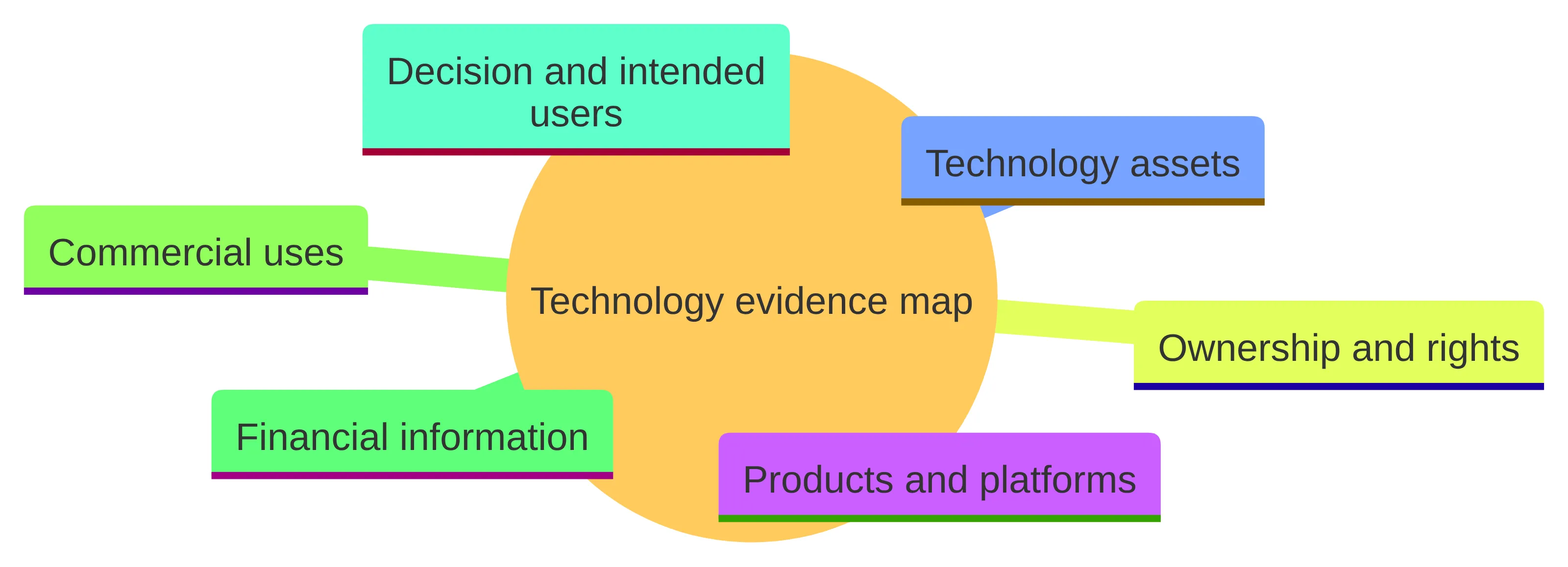
For an established technology company, prepare a technology evidence map. It can include:
- the products, platforms, models or services that generate revenue or support the operating plan;
- patents, trade marks, data assets, proprietary platforms, research and development work, and other identified technology assets;
- ownership records, licences, assignments, restrictions and relationships with founders, employees, contractors, universities or other organisations;
- the commercial uses, customers, markets and contractual rights connected with the technology;
- the financial information that links the technology to revenue, costs, investment and future assumptions; and
- the decision, intended users and level of reliance for the proposed output.
This is a preparation checklist, not a conclusion about value. It gives you a way to identify missing information and ask the provider what can be addressed within the proposed scope.
Our stated specialist scope is relevant when the decision concerns technology or IP. We have built our practice around valuing AI companies and technology businesses. We offer IP valuation and AI and technology valuation services, and we provide specialist valuations for AI companies, machine-learning platforms and algorithm-driven businesses. We also offer specialist valuations for patents, trademarks, data assets, research and development pipelines and proprietary platforms.
Those statements identify areas of specialist work. They do not turn every technology-related accounting question into a valuation assignment. Ask us to define the subject, purpose, assumptions, intended users and report requirements before you proceed.
Use these questions to test technology capability:
- Have you valued the type of asset or technology that is central to this decision?
- How will you identify the ownership interest or rights being assessed?
- What business, industry, financial and capital-structure information will you need?
- How will you treat assets that are operating in the business and assets that are not?
- What assumptions must management provide, and which assumptions will be tested?
- Who will use the output, and what reliance is appropriate?
A provider does not need to promise a particular result to answer these questions well. It does need to explain how the defined subject connects to the proposed work.
Check the engagement’s level of reliance
The same financial information can support different assignments with different levels of reliance. Before you share records or rely on a report, ask what procedures the provider will perform, what the provider will assume and what the output is designed to support.
The phrase “review the numbers” is not a sufficient scope. State whether you need information organised for management use, analysed for a decision, compiled into a defined format, tested for a particular purpose or used as an input to valuation or transaction work.
The cited APES 315 passage says that, for a compilation engagement, the accountant must obtain a sufficient understanding of the client’s business, operations and accounting principles and practices. The same passage says that verification of relevant information, internal-control assessment, and assessments of the reliability, accuracy and completeness of information supplied are not required unless the member has reason to believe the supplied information includes a misstatement.
That boundary matters. A compilation engagement should not be treated as independent verification simply because the resulting information looks formal. Ask what the engagement includes, what it does not include and what further procedures would be needed for your decision.
Before agreeing to work, ask for clear answers to these questions:
- Is the work compilation, analysis, valuation, assurance, transaction support or another defined service?
- What information will you provide, and what responsibility will the provider take for understanding it?
- Which information will be checked, reconciled, challenged or independently assessed?
- What assumptions will remain management’s responsibility?
- Who may use the output, and may it be shared with investors, lenders, buyers or other advisers?
- What limitations, qualifications or reliance statements will appear in the final document?
Record the answers in the scope. A verbal description can be misunderstood once the project becomes more complex.
For a technology company, include the technology evidence in this discussion. If revenue depends on a licence, if ownership is shared, or if a forecast depends on a research and development pipeline, the provider should identify how those matters affect the work. If the proposed engagement does not address them, ask whether the scope should change or another specialist should be brought in.
Proceed only when the level of reliance matches the decision. If you need an output for a defined valuation or transaction purpose, ask for a specialist engagement that expressly addresses that purpose rather than assuming a general accounting assignment will do so.
Apply the five-part adviser-fit screen
Once you know the decision and required output, assess the adviser against five practical criteria: capability, scope, independence, communication and fit. Use the same questions for every provider. That makes the comparison less dependent on polished descriptions and more focused on whether the proposed work can be delivered for your situation.
1. Capability
Test the provider’s experience against the actual subject, not merely the industry label. An established technology company may need experience with IP, AI, licensing, ownership rights, research and development, recurring revenue, platform economics or a transaction context. Ask which part of your decision the provider can address directly and which part requires another specialist.
Request a description of relevant work in terms that protect confidentiality. You do not need confidential client names or promised outcomes. You do need to know whether the provider understands the evidence and decision pathway you have defined.
2. Scope
Ask for the proposed subject, purpose, method, information requirements, deliverable, intended users, exclusions and timetable. The scope should say whether the output is for internal planning, a funding discussion, a possible sale, licensing negotiations or another defined purpose.
A broad service list is not a scope. The scope becomes useful when you can identify what you will receive and what remains outside the engagement. If the provider cannot explain the output in plain language, pause before sharing sensitive information.
3. Independence and conflicts
Ask how the provider identifies conflicts, manages relationships with other parties and separates analysis from advocacy. If the provider may advise more than one participant in a transaction, you need to understand the proposed role and any restrictions on acting.
Independence is not a slogan. Treat it as a question about the engagement, the parties involved, the intended use of the work and the provider’s responsibilities. Record the answer before proceeding.
4. Communication
Your adviser should be able to explain assumptions, limitations and conclusions without hiding behind technical language. Ask how questions will be handled, who will lead the work, how findings will be presented and whether your leadership team can discuss the result before it is used.
For a technology company, communication should include the link between the technology evidence and the financial or transaction question. If the explanation is limited to historic accounts, ask how the technology subject will be dealt with.
5. Fit
Fit concerns the decision, not personal preference alone. Check whether the provider’s size, availability, working style, geographic reach, reporting format and specialist network match the work you need. Confirm how the provider will coordinate with your existing accountant, lawyer, tax adviser, board and investors.
Use a simple record with three columns: requirement, evidence from the provider and unresolved question. Select a provider only after the unresolved questions have been addressed. If a requirement is outside the proposed scope, treat that as a boundary to manage rather than an issue to overlook.
Separate Sherwood’s supported specialist work from accounting assumptions
We offer sell-side advisory for IP assets and IP-rich businesses, managing the process from valuation to completion. We also structure and negotiate licensing arrangements to protect IP and capture its commercial value.
These services may be relevant when your decision concerns an IP asset, an IP-rich business or a licensing arrangement. They do not remove the need to define the parties, rights, commercial purpose, information available and other professional advice required for the transaction.
We provide AFSL-licensed valuations of businesses, IP and AI technology. We also walk clients and their advisers through the findings and deliver a written report after the valuation is prepared.
Use these facts to frame a focused enquiry, not to skip the scope discussion. The relevant questions remain: what is being valued, for what purpose, for whom, on what information and with what permitted reliance?
If your requirement is routine bookkeeping, general tax compliance, legal drafting or a financial decision outside valuation, licensing or the supported specialist scope, identify the appropriate professional separately. If your accounting provider already holds the financial records, ask how those records will be used in the specialist assignment and who is responsible for each conclusion.
A clean division of responsibility protects the decision process. It also gives you a more useful basis for comparing the proposed work with the problem you need to solve.
Use the Australian compliance checkpoint carefully
Australian compliance should be a checkpoint within the engagement, not a generic assurance statement. Bentleys states that aligning financial projections with Australian Accounting Standards and ASIC compliance is important for accuracy and regulatory compliance. Accounting standards also set the principles and requirements for recording and presenting particular transactions, balances and events in financial statements.
For your enquiry, ask which Australian requirements affect the proposed output, who is responsible for applying them and whether the work concerns financial reporting, projections, valuation, a transaction or another regulated activity. Do not treat a general reference to compliance as an answer to a specific question.
We provide AFSL-licensed valuations of businesses, IP and AI technology under AFSL Licence No. 563351. That statement concerns our valuation offering. It is not a blanket statement that every accounting, tax, legal or transaction service has the same licensing position.
When you discuss a valuation, ask what the licence, professional standards and proposed engagement cover, who may rely on the report and which matters require another adviser. Keep the regulatory status connected to the specific service rather than treating it as a substitute for scope.
Use this Australian compliance checkpoint before proceeding:
- Identify the service and the decision it supports.
- Name the Australian accounting, valuation or regulatory framework that the provider says applies.
- Ask whether the work is compilation, analysis, valuation, assurance or transaction support.
- Ask how the provider distinguishes compilation, analysis, valuation, assurance or transaction support.
- Confirm the intended users and permitted reliance.
- Identify the legal and tax questions that must go to qualified specialists.
- Put the boundaries, assumptions and deliverable into the engagement terms.
Regulatory language should make your decision clearer. It should not encourage you to rely on a service beyond its stated purpose. If the provider cannot explain the applicable boundary, pause and obtain the professional advice needed for the specific issue.
Prepare a focused first-enquiry brief
A focused first-enquiry brief gives the provider enough context to identify fit without requiring you to send your entire data room. Keep it concise, factual and structured around the decision. Your goal is to obtain a useful scope discussion, not to secure a conclusion before the work begins.
Include these sections:
- Company profile. Describe the company’s sector, operating model, scale in broad terms, ownership structure and stage of development. Identify whether the business sells software, services, data, hardware, licensing rights or a combination.
- Decision statement. Write one sentence describing the decision you are considering. Examples include assessing a capital-raising pathway, preparing for an exit, examining a licence or valuing a defined technology asset.
- Required output. State whether you need a valuation, financial analysis, scenario work, licensing support, sell-side IP advisory, transaction input or a referral to another professional.
- Intended users. List the people or organisations that may use the output, such as management, the board, investors, lenders, a buyer or another adviser.
- Technology subject. Identify the products, platforms, AI systems, data assets, patents, trade marks, research and development pipeline or proprietary tools that affect the decision.
- Ownership and rights. Note who owns or controls the relevant assets, where licences or assignments exist and which rights may be restricted.
- Financial context. Summarise the information available, the period it covers, the revenue or cost relationship to the technology and the assumptions you expect to matter.
- Constraints. State confidentiality needs, decision dependencies, relevant stakeholders and any known deadline without presenting the deadline as a promise about delivery.
- Existing advisers. Identify the people already responsible for accounting, tax, legal, finance, technology or transaction matters.
This structure allows the provider to identify what can be addressed directly and what should be handed to another specialist.
End the brief with questions that require a defined answer:
- Is this within your stated scope?
- What would you recommend as the first deliverable?
- What information would you need before confirming the scope?
- Which assumptions would remain with management?
- Which procedures would you perform on the information supplied?
- Which other professionals should be involved?
- Who would use the final output, and what reliance would be appropriate?
- What would you expressly exclude?
Send a high-level summary first. Share detailed financial, technical and contractual records only after the proposed purpose, scope and information-handling process are clear.
If your enquiry concerns a defined business, IP or AI technology valuation, explain the subject and purpose plainly. We walk clients and their advisers through valuation findings and deliver a written report after preparing the valuation.
These details help you frame the enquiry. They do not replace the discussion of intended users, assumptions, reliance or the other advice your decision may require.
Ask for a clear handoff plan
Complex decisions often fail at the handoff between professionals rather than at the start of the analysis. Ask each provider to state what it will deliver, what another adviser must decide and when the information should move between them. A clear handoff prevents the same question from being answered twice and reduces the risk that an unresolved issue is mistaken for a conclusion.
A workable sequence may look like this:
- Frame the decision. You identify the proposed action, the alternatives and the people who will use the result.
- Organise the financial information. Your accounting or finance team identifies the records, periods, assumptions and data limitations relevant to the question.
- Define the specialist subject. The valuer, licensing adviser or transaction adviser states what asset, interest, right or transaction is being addressed.
- Resolve legal and tax questions. The appropriate advisers assess contracts, ownership, obligations, approvals and tax consequences within their own scope.
- Integrate the outputs. You compare the financial, valuation, legal, tax and commercial conclusions without treating one document as a substitute for another.
- Approve the next action. Your board or leadership team decides what to pursue, what to change and what remains unresolved.
This is a planning sequence, not a prescribed engagement. The order may change when the facts require it. Ask the lead adviser to explain the proposed order and the dependency between each output.
Use a handoff note for every specialist. It should identify:
- the question being passed across;
- the information already supplied;
- the assumptions that remain open;
- the conclusion that is required from the receiving adviser;
- the document or meeting in which the conclusion will be used; and
- the person responsible for reconciling different views.
If a valuation depends on ownership rights, do not leave the ownership question implicit. If a funding view depends on a forecast, identify who owns the forecast assumptions. If a licensing arrangement depends on legal rights, separate the commercial analysis from legal drafting.
Ask the provider to explain what happens when the information is incomplete or contradictory. The answer should identify whether the work pauses, whether an assumption is recorded, whether additional procedures are proposed or whether another adviser must decide the issue.
Do not proceed on the assumption that a later professional will repair an unclear scope. Agree the handoff before you commit to the first substantive work.
Decide whether to make the enquiry
You can decide whether to make an enquiry by testing the decision against the output and the boundary. The purpose is not to prove that you need an adviser. It is to identify the next action that matches the information you have and the decision you are preparing to make.
Use these three paths:
Make a general accounting or finance enquiry
Choose this path when the immediate need concerns records, reporting, internal analysis or a defined financial planning task, and no specialist valuation, licensing, legal or tax conclusion is required yet. State the exact accounting or finance output you need and ask the provider to identify any specialist boundary.
Action: Approach a provider whose proposed engagement expressly covers that accounting or finance work, and agree the output before sharing detailed information.
Make a specialist valuation or licensing enquiry
Choose this path when the decision concerns the value of a business, ownership interest, IP, AI technology or another defined technology subject, or when the commercial question concerns an IP licensing arrangement. We offer IP valuation and AI and technology valuation services, specialist valuations for technology and IP subjects, sell-side advisory for IP assets and IP-rich businesses, and licensing arrangement support. cite
Action: Prepare the decision statement, subject, rights, intended users and required output, then ask for a scope discussion that identifies the information and specialist handoffs required.
Pause and clarify the decision
Choose this path when you cannot state what decision will be made, who will use the output or what the proposed adviser is expected to deliver. A broad request can create an engagement that produces information without resolving the actual question.
Action: Write the decision in one sentence, list the alternatives and identify the missing evidence before approaching a provider.
A defined specialist enquiry is more suitable when you can identify the subject and purpose. Our valuation services cover businesses, IP and AI technology, and we deliver a written report after preparing the valuation and walk clients and their advisers through the findings. These are service boundaries, not promises about a particular value, transaction result or commercial outcome.
Before you proceed, check that you can answer five questions:
- What decision will the work support?
- What output do you need?
- What information and rights are relevant?
- Who will use the result and how much reliance is appropriate?
- Which accounting, valuation, corporate-finance, legal and tax responsibilities sit with each professional?
If you can answer those questions, make the enquiry. If you cannot, refine the brief first.
Take the defined next step with Sherwood Australia
The right starting point is a defined decision, not a generic request for advisory support. For an Australian technology company, identify the subject, rights, financial context, intended output and people who will use the result. Then test whether the proposed provider has the technology, valuation, licensing or transaction capability required for that decision.
Our supported specialist scope is relevant when the question concerns business, IP or AI technology valuation, IP-rich business sale support or licensing arrangements. Individual suitability, and any accounting, tax, legal or financial advice required for your circumstances, must be determined with the appropriately qualified professional.
Prepare a concise brief with the decision, subject, ownership position, available evidence, intended users, required output and unresolved specialist questions. Bring that defined material to the first discussion so the scope can be assessed on the substance of your situation rather than on a service label.
What should a technology CEO clarify before contacting an adviser?
What is business advisory accounting and how does it differ from routine accounting?
Business advisory accounting focuses on decision-making support using financial information, rather than just maintaining records or compliance. It involves analyzing business choices, risks, and outputs needed by decision-makers.
When should an established technology company consider engaging a business advisory accountant?
A technology company may seek advisory support during significant decisions such as growth planning, restructuring, capital raising, acquisitions, licensing arrangements, or exit planning.
What criteria should be used to assess the fit of a business advisory accountant?
Evaluate an adviser’s capabilities, scope of services, independence, communication style, and overall fit with your company’s needs and decision-making process.
What types of outputs can a business advisory accountant provide?
Outputs may include management analyses, financial forecasts, valuations, transaction analyses, or referrals to other specialists, depending on the specific business decision at hand.
How can a technology company prepare for an initial enquiry with a business advisory accountant?
Prepare a brief that includes the company profile, decision statement, required output, intended users, technology subject, ownership rights, financial context, constraints, and existing advisers.
What should a technology company do if it needs both accounting and specialist valuation services?
Clearly define the decision and required outputs, then engage the appropriate specialists for each area, ensuring that responsibilities and handoffs are well understood.
How does Sherwood Australia support technology companies in terms of business advisory services?
Sherwood Australia specializes in valuing AI and technology businesses, offering services such as IP valuation, sell-side advisory for IP-rich businesses, and structuring licensing arrangements.