
Why classification and evidence come before goodwill
Purchase price allocation should begin with what you acquired and the evidence supporting each component, not with a decision to place an unexplained balance into goodwill. Under the cited AASB 3 material, the accounting path changes depending on whether the assets acquired constitute a business. If they do not, the transaction is accounted for as an asset acquisition rather than a business combination. That classification is the first question for an Australian acquisition team.
The practical sequence is straightforward, even though the underlying transaction may be complex:
- establish whether the transaction is a business combination or an asset acquisition;
- identify the assets acquired and liabilities assumed;
- separate identifiable intangible assets from goodwill where the applicable requirements call for that treatment;
- assemble evidence for the relevant fair-value analysis; and
- define how the accounting conclusion will be used under other Australian Accounting Standards.
AASB 3 states that an acquirer may recognise identifiable intangible assets that the acquiree had not previously recognised, including an internally developed brand, patent or customer relationship. At the acquisition date, the acquirer also classifies or designates identifiable assets and liabilities as necessary to apply other Australian Accounting Standards subsequently. Your allocation therefore needs an evidence trail, not only a final schedule.
The distinction matters particularly for technology acquisitions, where a deal may involve software, patents, customer relationships, data-related rights, contracts and research projects. Do not assume that the seller’s balance sheet captures every item relevant to the acquirer’s analysis. Ask the transaction accountant to assess the classification and applicable standard before you commission or review valuation work.
What purchase price allocation is designed to show
Purchase price allocation is the process of connecting the acquisition economics with the identifiable assets acquired and liabilities assumed. In the specific AASB 3 transaction context cited in the source material, cost is allocated to individual identifiable assets and liabilities on the basis of their relative fair values at the purchase date. The exercise is designed to show what the transaction acquired and how the relevant value is distributed across those items.
For a technology acquisition, the working allocation map may include:
- tangible assets that form part of the acquired business;
- liabilities assumed in the transaction;
- identifiable intangible assets such as brands, patents and customer relationships;
- an acquired in-process research and development project where it meets the definition of an intangible asset and is identifiable; and
- goodwill only after the applicable assets and liabilities have been considered under the relevant accounting requirements.
This list is a scoping map, not a conclusion about your transaction. The acquired company’s existing accounts do not, by themselves, settle whether an item should be identified by the acquirer.
For an intangible asset acquired in a business combination, the cited AASB 138 guidance states that its cost is its fair value at the acquisition date. That makes the date, the rights acquired and the information available at that date central to the analysis. A later forecast or revised commercial view may help you test assumptions, but it should not silently replace the acquisition-date question.
The allocation also creates a bridge between the transaction and subsequent reporting. Because the acquirer classifies or designates assets and liabilities at the acquisition date for the later application of other Australian Accounting Standards, the schedule should be prepared with its reporting purpose in view. Ask which line items require separate treatment, what assumptions support the measurements and which conclusions need accounting review.
Confirm whether the transaction is a business combination or asset acquisition
Transaction classification comes before the allocation mechanics. The cited AASB 3 passage requires you to determine whether the assets acquired and liabilities assumed constitute a business. Where the assets acquired do not constitute a business, the transaction is accounted for as an asset acquisition rather than a business combination. Do not carry a business-combination conclusion into the schedule without first documenting why the acquired set meets the applicable definition.
Use these questions to organise the classification discussion with your accounting adviser:
- What assets and liabilities transferred at the acquisition date?
- What operational, contractual and technological rights came with the acquired set?
- Does the acquired set constitute a business under the applicable Australian requirements?
- Which assets and liabilities require classification or designation at acquisition for later accounting?
- Which parts of the conclusion depend on facts that are still being confirmed?
The questions are a review structure, not a substitute for applying the standard to the transaction documents.
The classification boundary changes how you interpret the allocation. The AASB 3 passage that describes relative fair-value allocation and no resulting goodwill is limited to the transaction context described there. It should not be lifted into every asset acquisition or used as a universal rule for every technology deal. Record the classification conclusion, the relevant date and the facts supporting it before you debate individual valuations.
A deal label is not enough. Calling a transaction an acquisition, strategic investment or technology purchase does not answer the accounting question. Put the legal agreement, asset schedule, assumed liabilities and operating facts in front of the person responsible for the accounting conclusion, then let the classification drive the rest of the work.
Map the acquired technology and other identifiable intangibles
AASB 3 allows the acquirer to recognise identifiable intangible assets acquired in a business combination even when the acquiree had not recognised them in its own financial statements. The cited examples include an internally developed brand, a patent and a customer relationship. For a technology acquisition, begin with the rights and relationships transferred rather than relying solely on the seller’s asset register.
Build an asset-to-right map that separates the subject matter. Depending on the transaction facts, your review may need to distinguish:
- patents and other registered rights;
- proprietary software or technology covered by contractual or legal rights;
- brands and trade names;
- customer relationships;
- licences and other contractual rights; and
- in-process research and development.
This is a diligence and scoping list, not a statement that every listed item exists or qualifies in your acquisition. Trace each item to the agreement, register, contract, technical record or other contemporaneous evidence.
For intangible assets acquired in a business combination, the cited AASB 138 guidance treats the probability-recognition and reliable-measurement criteria as satisfied where the asset is separable or arises from contractual or other legal rights. The practical question is therefore whether you can identify the asset through separability or through rights acquired in the transaction, and whether the supporting documents describe what transferred.
An acquired in-process research and development project is recognised separately from goodwill if it meets the definition of an intangible asset and is identifiable through separability or contractual or other legal rights. Do not group an unfinished technology project into goodwill merely because it has not generated revenue. First document the project, the rights obtained and the facts that determine whether the definition is met.
A seller’s historical accounting treatment is useful background, but it is not the entire acquisition analysis. Internally developed assets may not have appeared as recognised assets in the acquiree’s financial statements. Ask for the underlying rights and transaction evidence before deciding that an item has no separate place in the allocation.
Treat rights and evidence as the basis for valuation
Valuation evidence should answer a defined reporting question. IVS 210 identifies intangible-asset valuations as commonly required for financial reporting in connection with business combinations, asset acquisitions and sales, and impairment analysis. It also says that the valuer should understand the purpose of the valuation and determine whether intangible assets should be valued separately or together with other assets.
For each proposed asset, connect four things:
- the right or resource acquired;
- the acquisition-date evidence showing what transferred;
- the valuation purpose and reporting use; and
- the assumptions that support the selected measurement.
This structure helps separate an asset’s existence question from its value question. A contract may establish a right, while forecasts, customer information or technical records may inform the analysis of its economic contribution. Keep those evidence types identifiable rather than placing them into one unsupported conclusion.
Do not assume that every technology-related item should be valued separately or that all related assets should be combined. IVS 210 places responsibility on the valuer to understand the purpose and determine whether intangible assets should be valued separately or together with other assets. Define the reporting question first, then ask how the proposed scope answers it.
We document the reasoning for our valuations in full. This is a process fact about our valuation work, not a conclusion that we prepare every purchase price allocation. If you are considering specialist input, ask for a scope that identifies the asset subject, valuation purpose, reporting date and evidence required.
Build the Australian PPA scoping file
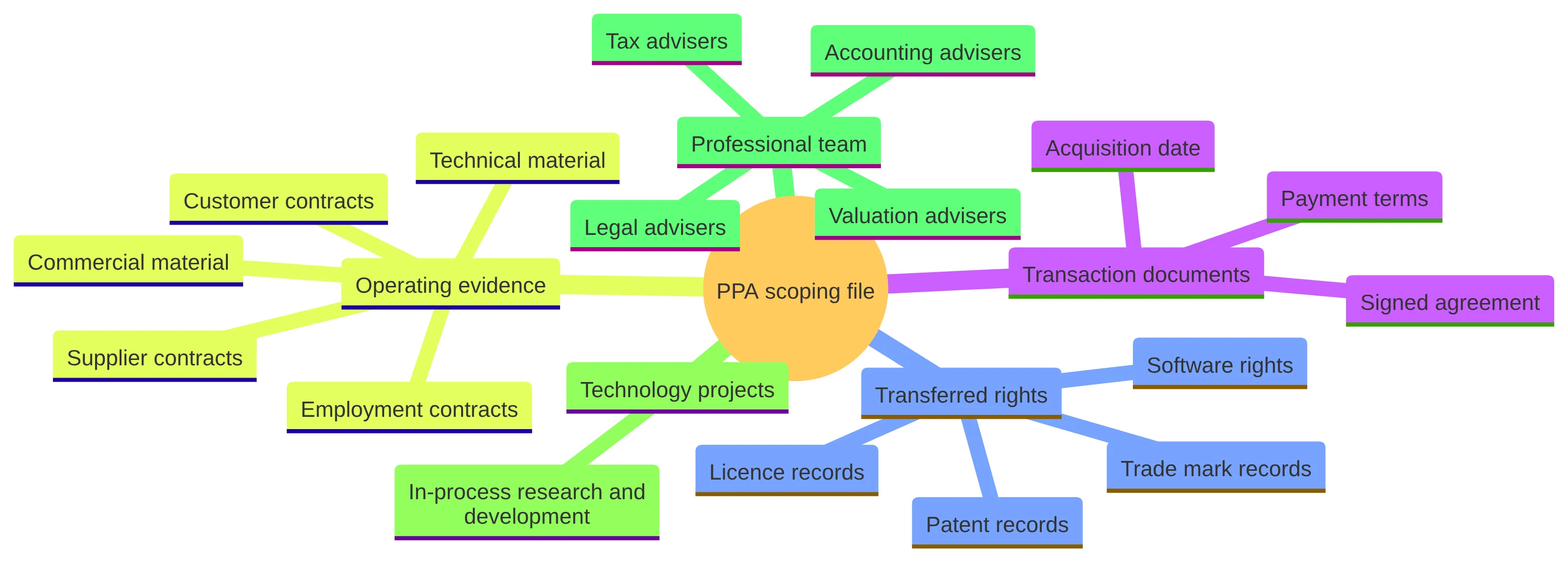
A useful scoping file lets your accountant and valuer work from the same transaction facts. It should show what transferred, when it transferred, which rights support the proposed assets and how the resulting analysis will be used in financial reporting. Keep the file factual and traceable; do not begin by assuming the answer is goodwill.
Assemble the following starting pack:
- the signed transaction agreement and amendments;
- the acquisition date and payment or consideration terms;
- schedules describing transferred assets and assumed liabilities;
- patent, trade mark, software, licence and other rights records;
- customer, supplier and employment contracts relevant to the acquired operations;
- descriptions of in-process research and development projects;
- historical financial information and management forecasts used in the transaction;
- technical, product and commercial material explaining how the acquired technology is used; and
- the names of the accounting, tax, legal and valuation advisers involved.
Label each document by the asset, liability or transaction question it supports. This makes gaps visible before a valuation scope is fixed.
Add a short question sheet beside the documents:
- What is the acquisition date for the analysis?
- Which acquired items are separable or arise from contractual or other legal rights?
- Which items require separate consideration under the applicable accounting requirements?
- Should any intangible assets be considered separately or together for the stated valuation purpose?
- What evidence supports the assumptions, and who owns each missing item?
- What will the report be used for, and who needs to review the conclusion?
The last two questions prevent a technically detailed valuation from being detached from its reporting purpose.
If the file cannot establish what transferred or which rights were acquired, pause the valuation discussion and resolve that information gap. Do not compensate for missing legal or technical evidence by increasing the level of numerical precision in the allocation.
Explain the goodwill effect without assuming the answer
Goodwill should be treated as an outcome of the applicable accounting analysis, not as the starting category for everything that is difficult to identify. Where an acquired business contains identifiable intangible assets, AASB 3 may require those assets to be recognised separately even if the acquiree never recognised them. That means the technology, brand, patent and customer-relationship review must happen before you settle the goodwill presentation.
For the specific transaction context described in AASB 3, cost is allocated to individual identifiable assets and liabilities using relative fair values at the purchase date, and the transaction does not give rise to goodwill. Keep that limitation beside the conclusion. It does not authorise you to apply the same result to a different transaction without first confirming the classification and applicable requirements.
When reviewing a draft allocation, ask three direct questions:
- Which acquired assets and assumed liabilities have been assessed individually?
- What evidence supports treating a technology-related item as identifiable or not identifiable?
- What specific accounting conclusion explains the amount assigned to goodwill?
If the schedule cannot answer those questions, return it for classification and evidence review rather than treating the unexplained balance as settled.
Separate accounting PPA questions from tax, legal and commercial questions
For accounting purposes, consider what was acquired, which assets and liabilities are identifiable, how the acquisition-date measurements are supported and how the items should be classified or designated for later application of Australian Accounting Standards. Those questions belong in the PPA review and should be answered against the applicable standard and transaction facts.
Tax, legal and commercial questions are related but separate. A valuation used for financial reporting does not, by itself, settle the tax treatment of an asset, the legal ownership of technology, the enforceability of a contract or the commercial price paid for the transaction. APES 225 distinguishes among valuation, limited-scope valuation and calculation engagements. Give each adviser a defined question and the documents needed to answer it.
Keep the workstreams separate in your file:
- accounting: classification, recognition, measurement and subsequent reporting treatment;
- tax: the transaction’s tax consequences and any tax-specific valuation requirement;
- legal: ownership, contractual rights, restrictions and liabilities; and
- commercial: integration plans, deal rationale, pricing and management decisions.
A single valuation number may appear in more than one discussion, but its purpose and assumptions should remain clear each time.
Before signing off, confirm the Australian standard version and effective date that apply to the acquisition. Transaction-specific conclusions still depend on the acquisition date, reporting framework and facts. Record that confirmation in the review file.
Decide whether specialist valuation support is proportionate
Specialist valuation support becomes more relevant when the allocation includes material technology rights, several interdependent intangible assets, in-process research and development, limited internal valuation capability or a reporting conclusion that needs a documented valuation basis. IVS 210 identifies intangible-asset valuation as common in business combinations and asset acquisitions. APES 225 examples include intangible-asset, intellectual-property and limited-scope valuation work connected with transactions.
Ask the proposed valuer to define the engagement under the applicable APES 225 terminology. APES 225 distinguishes valuation engagements, limited-scope valuation engagements and calculation engagements. Its examples show that the label depends on the work performed and the report or output provided. Do not select a label because it sounds sufficient; match the scope to the asset questions, evidence available, reporting use and level of conclusion required.
We offer specialist valuations for patents, trademarks, data assets, R&D pipelines and proprietary platforms. Our valuations are prepared in accordance with APES 225 and International Valuation Standards by an AVI Certified Business Valuer (AVI 20281). We can discuss whether a defined valuation scope fits the asset and reporting question; we do not determine your accounting treatment from a general description of the transaction.
Use this decision test before seeking support:
- If the asset map is incomplete, resolve the transaction and rights evidence first.
- If the asset map is clear but the measurement is material or technically difficult, define the valuation subject and purpose.
- If the work is limited to assumptions or a calculation, ask how that limitation affects the output.
- If the report will support financial reporting, make the acquisition date and applicable standard part of the brief.
The appropriate next step is a defined scope, not an automatic full valuation or an unsupported internal estimate.
Use a review checklist before closing the allocation
Before you close the allocation, work through this checklist:
- Classification: Is the transaction documented as a business combination or asset acquisition under the applicable requirements?
- Date: Is the acquisition date clear, and are measurements tied to that date?
- Assets and liabilities: Does the schedule identify the acquired assets and assumed liabilities rather than relying on the seller’s account names?
- Intangibles: Have brands, patents, customer relationships, contractual rights and relevant research projects been assessed for identifiability?
- Rights: Does each proposed intangible link to separability or contractual or other legal rights where that test applies?
- Measurement: Does each material value have an identified method, evidence base and assumption set?
- Goodwill: Is the goodwill conclusion explained by the applicable accounting analysis rather than used as an unexplained balance?
- Subsequent reporting: Has the classification or designation needed for later Australian Accounting Standards been reviewed?
- Scope: Does any valuation engagement match the reporting purpose and the evidence available?
Then ask the people reviewing the file:
- Can each significant allocation line be traced to a transaction fact or valuation assumption?
- Can the accounting conclusion be separated from tax and legal conclusions?
- Is the proposed valuation work described accurately as a valuation, limited-scope valuation or calculation engagement?
- Does the report explain its purpose, subject, date, evidence and limitations?
- Are unresolved facts listed with an owner and a next action?
A clean checklist does not replace professional judgement. It gives your team a common way to identify where that judgement is still required.
If a material answer remains uncertain, leave it marked for review. A precise-looking allocation with an untested classification, unclear rights or an undefined valuation purpose is not ready for sign-off.
Confirm current requirements and define the next valuation discussion
A defensible Australian allocation starts with classification, then follows the acquired rights, identifiable assets, liabilities, acquisition-date evidence and reporting purpose. Goodwill should not be assumed before those questions are answered. Confirm the applicable Australian requirements and effective dates for your transaction, and have a qualified accountant, tax adviser or lawyer decide the transaction-specific treatment within their area of responsibility.
We document the methodology and evidence relied on for our valuations. Bring a defined asset map, acquisition date, rights record and reporting question to the next discussion so the proposed scope can be assessed against the actual transaction.
Practical questions about purchase price allocation in Australia
How does the classification of a transaction as a business combination or asset acquisition affect purchase price allocation?
The classification determines the accounting treatment; if the assets acquired do not constitute a business, the transaction is treated as an asset acquisition, which may not follow the same allocation principles as a business combination.
When should a company consider obtaining specialist valuation support for purchase price allocation?
Specialist valuation support should be considered when the transaction involves complex technology rights, multiple interdependent intangible assets, or when there is limited internal valuation capability.
What documentation is necessary to support a purchase price allocation?
Necessary documentation includes the signed transaction agreement, asset schedules, records of rights acquired, and any relevant financial information that supports the valuation assumptions.